
Welcome to my next stupidly ambitious project …
Welcome to my next stupidly ambitious project …
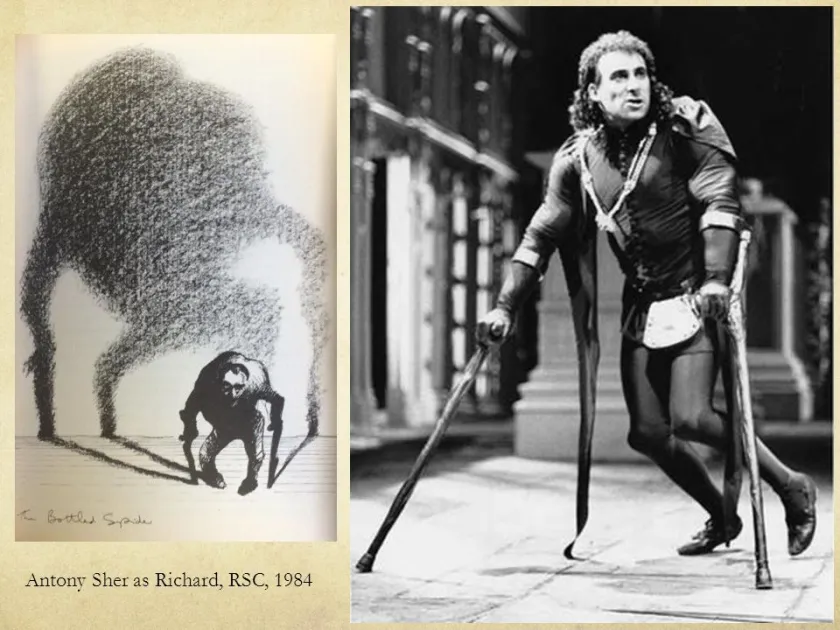
It’s nearly a year (where has the time gone?) since I last picked up a book and decided I’d love to get down the pub for a session with the author (and bear in mind I’m still not drinking: day 70 today). Imagine me, Anthony Sher and Michael Bogadanov setting the Shakespearean world to rights over a few scoops …

And we’re back with Forensic Fridays …
Partly because I’m teaching Richard III to a new A Level class, partly because my exam class will benefit, should they ever visit (you know who you are), and partly because yes, they are fun.
You can see the full rules here, but if you’ve been before, the task is to write a prize-winning forensic analysis of a very short extract in just 250 words, working to OCR’s mark-scheme in order to provide some models for my students.
In this passage, I returned to the dramatic moment when deposed Queen Margaret of Anjou, devastated by the killings of her son and then her husband (within 17 days, historically), calls down the heavens to curse Richard, Duke of Gloucester, who in the Henry VI cycle did what had to be done. It’s a very tense moment …
Infamy, infamy, they’ve all got it infamy …

Maybe it’s growing up in the 70s, but I enjoy an infantile dirty joke as much, if not more, than the next fellow. They don’t always work in the plays, or perhaps audiences are now vastly more sophisticated: I can imagine that even the weakest ones would have had them rolling in the aisles at The Globe.
This week, I decided to work my favourite Shakespearean knob-gag … ooh err!
Richard II = Edward II = Prospero = Duke Vincentio = Henry VI = every useless boss you have ever worked for,
Richard II appears on my reading list for Edward II each year. It’s not just me – this is what Jonathan Bate, who I recently gushed about, has to say:
Richard II’s relationship to Edward II is so obvious that it is not very interesting. The structure of the two plays is identical: the King is surrounded by flatterers and pitted against an assemblage of nobles with vested interests of their own, then isolated and uncrowned, stripped of his royal identity, thus forced to discover his inner self by means of a supple, reflective soliloquy delivered whilst humiliatingly in prison. In each play the Queen is pushed to the margins in part because of the king’s homoerotic leanings. Marlowe is bolder than Shakespeare in his explicit portrayal of the homosexuality and his neat device of joining the Queen with the rebels in revenge. [a]
It should be easy to find something in Richard which’ll look familiar to my Edward students, right? Let’s have a go …
At £20+, you need a real connection to the play to get your money’s worth.
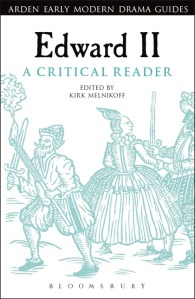
Kirk Melnikoff (ed.), Edward II: A Critical Reader (Arden Early Modern Drama Guides), (Bloomsbury Publishing: London, 2017)
This is my first taste of the Arden Early Modern Drama Guides series; my overall impression was a positive one.
Continue reading “(book review) Melnikoff: Edward II – A Critical Reader”
Without any protection from his class background, Gaveston’s fall was always going to be fatal.

Meet Alex Honnold:
‘history’s greatest ever climber in the free solo style, meaning he ascends without a rope or protective equipment of any kind.'[a]
Just researching a picture for this post made me feel a little nauseous …
Continue reading “Forensic Friday (#09): Edward II (iv.400-407)”
Thankfully, we can’t have a third series of The Hollow Crown, but what about adaptations of the Roman plays?

If there’s one thing my (currently stuttering) Pony Tail Shakespeare read-through project has given me so far, it’s a greater love for the History Plays. Once the project is (eventually) finished, I’m looking forward to reading them again merely for pleasure.
Continue reading “Quotation* of the Week: 13 August 2018 (#53)”
Gifted, abominable, yet capable of producing ‘the mighty line’ …

It’s episode 52 – not a continuous year (the first post is here), but a year nonetheless, so I’m going to indulge myself a little this week. Will you be able to tell the difference, I hear you ask!
Bear with me whilst I tell you a story:
In eighteenth-century France there lived a man who was one of the most gifted and abominable personages in an era that knew no lack of gifted and abominable personages. His story will be told here. His name was Jean-Baptiste Grenouille, and if his name – in contrast to the names of other gifted abominations, de Sade’s, for instance, or Saint-Just’s, Fouché’s, Bonaparte’s, etc. – has been forgotten today, it is certainly not because Grenouille fell short of those more famous blackguards when it came to arrogance, misanthropy, immorality, or, more succinctly, wickedness, but because his gifts and his sole ambition were restricted to a domain that leaves no traces in history: to the fleeting realm of scent. [a]
‘Know your place’, the world of literature seems to scream. ‘Or else …’

If there’s anything I enjoy as much as anti-heroes, it’s tales of Promethean over-reachers.
Christopher Marlowe belongs in that category, I believe …
Continue reading “Forensic Friday (#07): Edward II, (iv.15-21)”
 The Boar's Head, Eastcheap