‘death, a necessary end, will come when it will come’ (JULIUS CAESAR: Act II, sc ii)
subtitled:‘The not very tragic or lamentable death of the serial rotter, Suffolk, and the deservedly doomed distraction caused by Cade.’
It’s not quite acts three or four of Antony and Cleopatra, but this act does get into double-figures in terms of scenes – something I find irritating as a reader, in a way that I don’t find when listening to or watching the plays. Still, basically, Act IV boils down into two episodes, as the subtitle suggests.
This country ain’t big enough for the two of us … bitch!
What mightst thou do, that honour would thee do,
Were all thy children kind and natural!
But see,thy fault France hath in thee found out,
A nest of hollow bosoms. (CHORUS, Henry V: II.0.18-21)
Henry VI II: Act I
It’s a strange thing, patriotism.
I’ll try to make this the final time I mention how I don’t feel especially patriotic towards England as opposed to Britain, but the beginning of the play causes me to examine my attitudes again.It probably says something about my pedantic nature that I can’t simply conflate the two.Or maybe it’s simply the fact that my Welsh girlfriend would probably dump me!Either way, I suddenly became acutely aware of an inchoate fear for the country.Ye-e-es, there was some fear for Henry, about to be eaten alive by his Queen like a hapless spider, but the sympathy I felt for Henry as a child effectively evaporated in the white heat of his ineffectuality.It facilitated of the betrayal of my new Shakespearean heroes, the Talbots, and so isn’t easily forgiven or forgotten.So it wasn’t what Margaret might or might not do to Henry that worried me.It was how she might treat England …
I wanted to reflect on the play as a whole, looking back to my ‘Expectations’ back at the end of January.
Good literature is like a magic trick.It makes you believe you are in a different time and place, and care for characters who are constructs, and react to their (also fictitious) actions as if you were a participant.
A cheeky way of muscling in some commentary on one of my favourite plays, way ahead of SCHEDULE?Perhaps. I shouldn’t be discussing Julius Caesar (let alone Star Trek) until September 2018 …
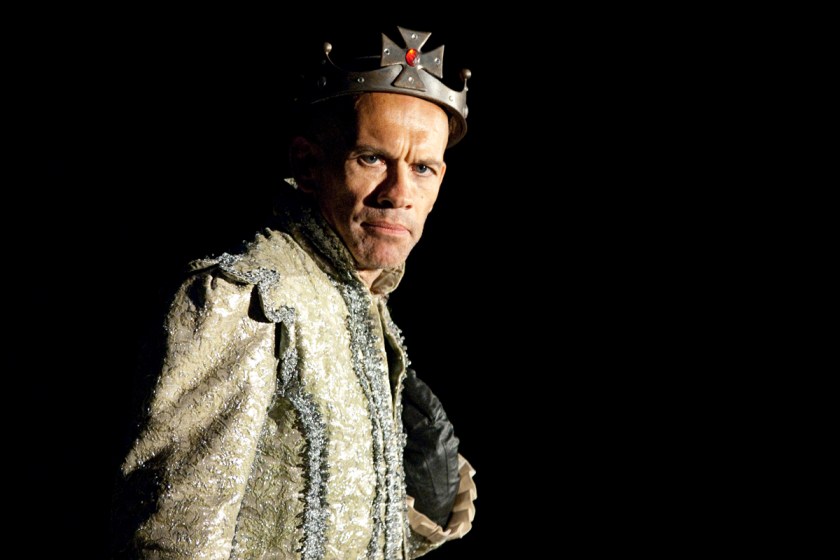
I took this image of ‘Richard’ at the Cambridge Shakespeare Festival in 2013.
“I am unfit for state and majesty”
Why do we still study Shakespeare 400 years after his death?
Our year 12 stint on Richard III is now beginning to wane – we start Act 5 next week, and will essentially be done by the end of the Autumn Term on 16 December. Then I’ll sadly take a break from teaching Shakespeare until after Easter, when I’ll be looking at Much Ado About Nothing (year 8), probably Hamlet or Julius Caesar (year 9), and Macbeth (year 10). My only ‘early modern’ fix in the Spring term is Marlowe’sEdward II. Happy Days.
As the year 12 course has unfolded, keeping pace with the final stages of the US elections, I’ve found it increasingly difficult to leave the next leader of the free world out of our discussions. With one difference: I grudgingly admire one of these larger-than-life characters, and have nothing but contempt for the other …





 The Boar's Head, Eastcheap