“There is differency between a grub and a butterfly;
yet your butterfly was a grub.” (Coriolanus, V, iv [a])
It would be too easy to blame my changed reading habits in 2018 on professional busy-ness, or on my health, but there’s no escaping a startling and depressing fact …
Ken Dodd (and his infamous tickling stick): ‘I haven’t spoken to my mother-in-law in eighteen months. I don’t like to interrupt …’
You probably know my taste for puerile humour by now.
This joke (and there are many versions of it knocking around) has been a favourite since before I got married, a good twenty years ago. You can imagine how well it went down, the first time I used it on my (rather fierce) ex-mother-in-law. I received what we might call an ‘old-fashioned look’, with added chilli. Nowadays, poking fun at someone’s verbosity is also self-referential, because, yes, I unashamedly like to talk! In my defence, it’s because I ‘live’ in 1592.
Sure, it’s only a week away from school, and I ought to be able to control myself. Many of you will also have a handle on the state of my bookshelves – I have no space for these, and yet. Half-terms are an opportunity to catch breath in more ways than one.
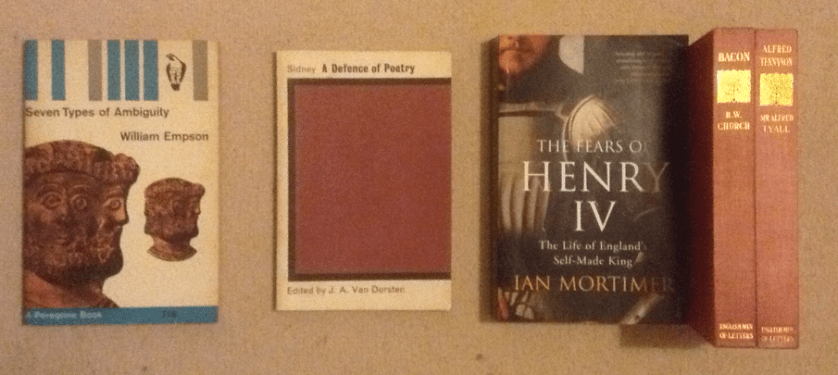
Some would suggest I oughtn’t to have bought anything; I like to think of this as a fairly restrained Book Haul, all sourced from the second hand bookshop about 300 yards from ‘her place’. So, what and why …
Regular visitors know that I teach Richard III and Edward II at A Level – coincidentally, plays which seem to have appeared within months of each other, in or around 1592. Marlowe doesn’t get discussed much in the circles I move in online, and Edward II often feels even more overlooked – so when someone wanted to talk about the differences between Kit and Will on /r/shakespeare (after watching a performance of Tamburlaine), I couldn’t resist diving in. Here’s an edited extract of what I said:
Can we just stop putting ideas in Shakespeare’s head, please?
GNU Sir Terry Pratchett
… just busy.
And increasingly grumpy … when I’ve found no time to blog, other than a single new Golden Dogberry.
Autumn Term is always a log-jam, and my least favourite of the three. I told my better half today that whilst there had been a LOT of time at home and weekends where I was too busy to see her, there wasn’t really any ‘me time’ in there. I haven’t read anything for weeks, and obviously, the blog has suffered. At least our school has finally been inspected now after years of being on ‘DEF-CON2’, and with any luck we won’t see THEM for a while …
‘Books are delightful society. If you go into a room and find it full of books – even without taking them from the shelves they seem to speak to you, to bid you welcome.’ William Ewart Gladstone
This post came out of a discussion on Reddit where I asserted that we weren’t seeing enough Shakespeare shelf-porn. SHAKESPORN, in fact. Yup. You heard me. So in the spirit of ‘I’ll show you mine; you show me yours‘, here’s a tour of my Shakespeare bookshelf: MY ‘delightful society‘ …
Studying a History play? Look for the playwright’s sources …
My Marxist critical inclinations – that a text can’t be read in isolation from the contextual crucible that created it – get pretty much free reign when it comes to teaching Edward II. For the OCR A Level course, my students need to compare Marlowe’s drama to Tennyson‘s monodrama, ‘Maud‘ and, get this, 50% of the mark is context (that’s AO3, troops).
What, exactly, is context? I’d suggest that for both texts, maybe all texts, context is usually a mix of two things:
Jonathan Bate: The Genius of Shakespeare (Picador: London, 2008)
Professor Bate will probably be a familiar face, or voice, to anyone on the ‘Shake-scene’ in the UK. You can hear him participating in Shakespeare-themed episodes of BBC Radio’s ‘In Our Time’, he heads a University of Warwick MOOC on ‘Shakespeare and his World’, and amongst his many written accomplishments, he edited the Arden third edition of Titus Andronicus.
This is such an engaging book. Because ‘you don’t read Shakespeare, he reads you‘, we learn almost as much about Professor Bate as we do about Shakespeare. If you want to know what a modern Shakespeare scholar is like, you could do worse than start here.






 ‘Books are delightful society. If you go into a room and find it full of books – even without taking them from the shelves they seem to speak to you, to bid you welcome.’
  My Marxist critical inclinations – that a text can’t be read in isolation from the contextual crucible that created it – get pretty much free reign when it comes to teaching
  Jonathan Bate
 The Boar's Head, Eastcheap