Love it, hate it? Just try it, and see what happens …
Stephen Greenblatt: Tyrant: Shakespeare on Power, (Bodley Head: London, 2018). ISBN: 9781847925046.
– – –
I probably need to declare my bias, not least for new visitors.
I’m an unashamed socialist (I don’t understand how an educator could be otherwise, given that our efforts benefit society more than ourselves); I’m anti-Brexit in the UK, and anti-Trump in the US. One of my most popular blog posts, from two years ago, equated Richard III with Trump. “I am unfit for state and majesty” indeed …
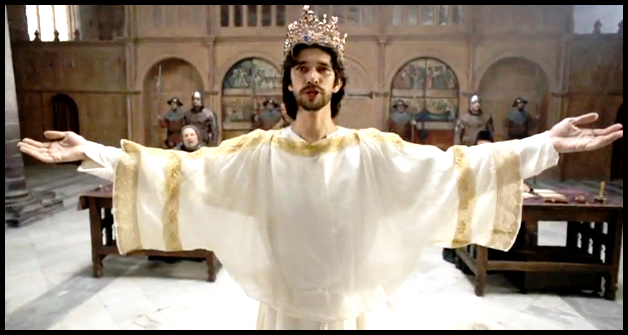
All the world IS a stage, where Richard is concerned …
Year 12 face their mock exam this coming Friday, with varying degrees of panic.
So, this week’s QotW is actually a BOGOF offer. I often talk about Richard III being a ‘season finale’ to the History plays. The chameleon quotation above comes from the penultimate episode, as you might remember, people. Richard is – at least until it all begins to unravel for him – the consummate actor.
Why’s it taken me so long to get this one written? To get this play finished? To ‘officially’ say goodbye to Richard II for a few years, given I have no opportunity to teach it at either GCSE or A Level? That question probably contains its own answer.
Or, the fact that it’s Romeo and Juliet next …
You know – if you’ve been reading along – how deeply I feel an affinity for Richard’s journey. Perhaps when I (eventually) get to the end of the PTS I’ll reflect that the ‘most important things are the hardest things to say‘, as Stephen King tells us [a]. It’ll be interesting to look back and see whether the plays I found harder to connect with came and went rather quicker.
A nice positive GIF for my Y12 class … you CAN score, people!
‘SQUEAKY BUM TIME’: the point towards the end of a football game, or season, when you hold a slender lead but are almost shitting yourself, in case something goes horribly wrong …
– – –
I’m publishing this with a exactly a week to go before my Y12s face their end of year exam – a full exam on everything we’ve done this year: Tennyson‘s ‘Maud’; Marlowe‘s Edward II; and of course, Richard III. Evidence suggests my students are in full ‘squeaky bum’ mode, despite my best efforts to reassure them. And, hey, it’s the World Cup: if Mexico (one of ‘my teams’ can hang on to a 1-0 lead for an hour against Germany, I think you can hang on to what I have taught you this year for another seven days?
You know what to do: especially (for the first question) if you have been reading these …
Marlowe was never going to fit in. In some ways I wish he hadn’t tried so hard – he would have lasted longer.
What?
‘We don’t like mavericks here …’
– is what I was told some years back at my first school. My first school, just to be clear …
It’s not a default position, I promise you – I honestly don’t aspire to be a maverick. It’s simply about my always bearing in mind the attributed words of Einstein: the definition of insanity is doing the same thing again and again and expecting different results. So if it demonstrably doesn’t work or doesn’t make sense, you need to find someone else, if you want blind obedience. How do we improve, otherwise? Plus, my teaching mentor gave me advice I’ve never forgotten, and which has served me well (and my students, if results are anything to judge by*). We might paraphrase it as: ‘As long as you know where should be taking the students, don’t stress about abandoning the lesson plan and getting there via another route.‘
So, admittedly, I can be a:
maverickˈmav(ə)rɪk/ noun
1. an unorthodox or independent-minded person.
But, surely, no SURELY, this what we aim to foster in our children (what actually we reward in the subject: critical, evaluative thinking and independence of ideas – those terms are on the markschemes, at the top end) … right? Or does education exist to train people into unthinking passivity?
It’s dawning on Clarence that he won’t talk his way out of this one …
“Do you do ‘PEEFE’* on Saturday nights, Sir?” one wag asked me, to general titters of amusement in C5.
‘Why not? It’s fun.’ I replied. And it is. So why not?
Why not, actually, spend some time thinking again about RIII, I.iv? Thinking about a grown man who has such a terrifying nightmare that he asks another to sit with him whilst he tries to get some sleep. About a man desparately pleading for his life in every way he possibly can (see the Blues Brothers, above), when faced with two murderous executioners. Much more fun than Love Island, surely?
“Let’s leave politics out of Shakespeare” … Hello? Hello? Anybody in there?
image: thrillist.com
If I had a pound for each time I was challenged, ‘What’s Shakespeare got to do with me?‘, this blog would have more bells and whistles on it, as well as many more posts to reflect not having to work for a living.
This week’s post was prompted in part by reading somewhere in my recent internet travels, the notion of ‘keeping politics out of Shakespeare.’ That plus a ‘setting the world to rights‘ drinking session which was actively, intensely political, and which was also chock-full of Shakespearean dilemmas and situations.
What kind of teacher asks their students to do something they wouldn’t do themselves?
My latest Y12 Homework task was titled, yes, This Charming Man – students were asked to analyse the exchange between Richard and Anne in Act I scene ii of Richard III. Those who were feeling a bit flash were challenged to get in as many song titles as they could from The Smiths discography.
Students laugh when they hear it, but Anne was in deadly earnest …
We have hedgehogs.
I say ‘we’, but I’m appropriating the cute nocturnal visitors at my Snowdonia home (also known as ‘her place‘) …
Having spent most of the week camping in the back garden – yes, by choice – I’ve become a lot more familiar with their comings and goings: their enthusiastic crunching of mealworms (these are spoiled, and resolutely ignore the slugs they are supposed to be eating – I’ve seen them nudge slugs aside with their snouts!); their irritated huffing and snorting when a rival appears at bowl number two, all within a couple of feet of my head.
Which, of course, makes me more sensitive to the hedgehogs – just three of them* – in Shakespeare …

 Stephen Greenblatt: Tyrant: Shakespeare on Power, (Bodley Head: London, 2018). ISBN: 9781847925046.





 The Boar's Head, Eastcheap