Cultural Capital 02: The Book of Genesis

It doesn’t get much more influential than the ‘good book’ in English Literature …

BH blues brothers
Do you see the light?

[Second in a series of articles aimed at our ‘A Level’ students, addressing gaps in their general and literary knowledge.  Read the previous article, On Dante’s Inferno, here]


Jehovahs Witnesses‘Good morning [big smile]!

In the Christmas season, who do you think is the greatest gift-giver of them all?’

(this happened to me a few weeks back)

No – don’t slam the door !  I’m genuinely not here to convert you.  But if there’s just one text that has gifted the most sources of inspiration and allusion to our Western literary tradition, it’s probably the Old Testament Book of Genesis.  Estimates vary, but its very strong messages on obedience and patriarchy have been influencing society for about 3,000 years.

This would be the book to choose alongside Shakespeare’s Complete Works when looking for the most influential literary works.


Continue reading “Cultural Capital 02: The Book of Genesis”

PTS 09/054: 400 Year-Old Smoke Signals

Sometimes the smoke is easier to read than others …

BH smoke

Love’s Labour’s Lost – Act III

Inspired by Ursula K Le Guin and The Pet Shop Boys, I picked this up again with a steely glint in my eye.  I’ll read.  I’ll gloss.  I’ll conquer!

Continue reading “PTS 09/054: 400 Year-Old Smoke Signals”

Quote of the Week: 15 January 2018

Art not just as a time machine, but as a mirror, too …

BH germaine-greerGermaine Greer:  Shakespeare (Past Masters series) (Oxford University Press:  Oxford, 1986)

I wonder if there was a time when, at least as an adult, the name Germaine Greer was unknown to me.  Yet this slim volume, picked up in the last mad pre-demolition trolley dash round our old sixth-form building almost a year ago, is my first reading of any of her works.  I feel a bit embarrassed about that.

Continue reading “Quote of the Week: 15 January 2018”

PTS 08/048: Man is not truly one …

Antipholus (E) is NOT a twenty-first century role model – but was he a sixteenth-century one?

BH jekyll hyde

… but truly two.’  Robert Louis Stevenson, The Strange Case of Dr Jekyll and Mr Hyde.

PTS read through:  Comedy of Errors, Act IV

In 2018, the notion of what it means to be a ‘man’ feels ever more opaque, with behaviours and attitudes being scrutinised as never before, perhaps.  As a gender, we sometimes appear confused about the path we ought to take to find a satisfying and yet socially acceptable direction or self-definition.

Maybe it was ever thus.

In yesterday’s post on Macbeth I touched upon the fragility of our hero’s notions of himself when his masculinity was challenged by his wife.  Macbeth is largely a play about what it means to be a man, but that’s way down the line in terms of my reading schedule.  Reading Act IV of Comedy of Errors felt like one of those non-comic interludes towards the end of plays like Much Ado About Nothing, and instead of laughing, I found myself thinking about what Antipholus (E) implies a ‘man’ should be.  It’s not an attractive picture …

Continue reading “PTS 08/048: Man is not truly one …”

2017: In Bed With Shakespeare

What I read in 2017, what YOU should read in 2018, and what to avoid like, ahem, the Plague …

BH Hathaway bed

Announcing my Ponytail Shakespeare read-through back in January did something to me; maybe several things.

Firstly, it made a public commitment. I’m just a bloke, and a busy one at that, being an English teacher, but I am still following the schedule – albeit several paces behind.

It also made me realise that however confident I might be, there was/is an awful lot I don’t/didn’t know for someone who enjoys being the ‘go-to’ at work for all matters Shakespearean – those ‘known unknowns’ were simultaneously a cause for embarrassment and a spur to do better.

These two ingredients combined to make me jump into bed with Shakespeare in 2017 …

Continue reading “2017: In Bed With Shakespeare”

PTS 08/047: Cheats Never Prosper?

Near misses, and fascinating Misses – Luciana’s journey continues …

BH why-do-women-cheatPonytail Shakespeare read-through:  The Comedy of Errors, Act III

We’ll come to the idea that ‘cheats never prosper‘ in a while.  It’s a busy act.

In the meantime, sometimes the margins in comedy and tragedy are very, very fine. Exactly like in real life, actually …

Continue reading “PTS 08/047: Cheats Never Prosper?”

Quote of the Week: 18 December 2017

The more things change, the more they stay the same …

BH neale coverNeale, JE:  Queen Elizabeth I (Pimlico:  London, 1998)

Once again, I’m minded to say that we continue to study EMP Literature because whilst times and technology have undoubtedly moved on, human attitudes and the situations we face remain broadly the same.

Endemic Xenophobia?  Check.

Effemination of rival men who dress too well?  Check.

Aristocratic disdain for ‘upstarts’?  Check.

‘Plus ça change, plus c’est la même chose,’ as Jean-Baptiste Alphonse Karr (another foreigner*, dammit!) might say …

Continue reading “Quote of the Week: 18 December 2017”

Yesterday, and yesterday, and yesterday …

What’s not to like about spreadsheets? Except they make clumsy timelines …


BH nicholson joker

It feels like it needs a little refinement, but the future is here!  And I feel like my friend’s daughter when she spots a park from about half a mile away! PLAYYYYYY!

For some considerable time, I’ve been known as someone who guiltily, geekily enjoys spreadsheets and will create one at the drop of a hat.  I mean, what’s not to like? Especially when I get going on conditional formatting and things like that – you should see my school mark-books!

But there was one area where I felt Excel (or Numbers, actually) was letting me down.

Continue reading “Yesterday, and yesterday, and yesterday …”

Quote of the Week: 27 November 2017

Are our masters “fettered with chains of gold”? Sir Thomas Wyatt (1503-42) thought so. Perhaps we could ask Theresa May …

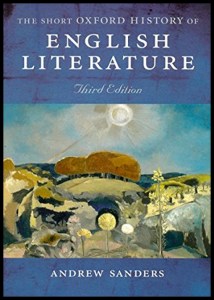
BH Sanders OXford History

Andrew Sanders, The Short Oxford History of English Literature (Oxford University Press, Oxford, 2004)

(A book I rescued – for under 50p – from a Greater Manchester library who had withdrawn it because it was not being taken out …)

I’m going to step back a little to someone who operated before Shakespeare lived, but will have influenced the development of poetry up until our boy arrived on the Shake-scene.

Continue reading “Quote of the Week: 27 November 2017”

Model Answer: Edward II CBA

Anything other than modern ‘exclusivity’ could mean demotion and starvation at best, or – more likely – imprisonment, exile, or execution.

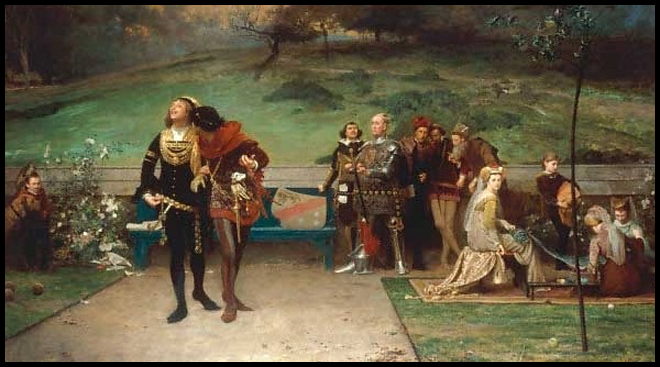
BH Marcus Stone
Painting by Marcus Stone:  Edward and Gaveston frolic in front of Isabella et al

CLASSROOM BASED ASSESSMENT:  In Edward II, love is invariably possessive.  Discuss.

Weightings:  AO1 (25%); AO3 (50%); AO5 (25%)

God, I hate this question.

One of the things that I got from my teacher training, back in the day, was that if you asked a poor/stupid/inaccessible question, you only had yourself to blame for crap answers.  This is an OCR question – at least the students get a choice of six to answer for their final exams.  But for reasons beyond my ken, or immediate power to change, it is our first CBA on Edward II.  It also comes too early in the course for people who were in school uniform less than 6 months ago to be asked to deal with AO5, if you ask me.  They were being constantly drilled in AO2, and for this essay, it’s not required …

But enough whinging.  In the spirit of never asking people to do something you wouldn’t do yourself, here’s a model answer for my class to play with.  I tried to do this in the same conditions they were asked to do it in, without any ‘cheating’ on my part.

IF THIS IS THE FIRST TIME YOU’VE HAD A LOOK AT ONE OF MY ESSAYS, PLEASE CLICK HERE FOR THINGS YOU NEED TO KNOW.

Continue reading “Model Answer: Edward II CBA”