
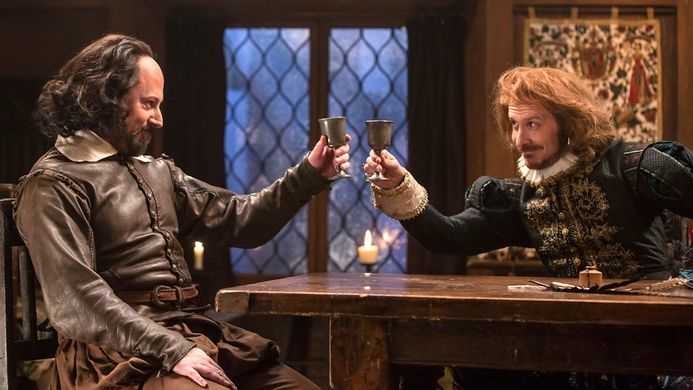
To begin, a little quiz. What connects the following texts?
- Ian McEwan: On Chesil Beach (2007)
- Alfred, Lord Tennyson: ‘Maud’ (1855)
- Christopher Marlowe: Edward II (1592)
- William Shakespeare: Richard III (1592), and
To begin, a little quiz. What connects the following texts?
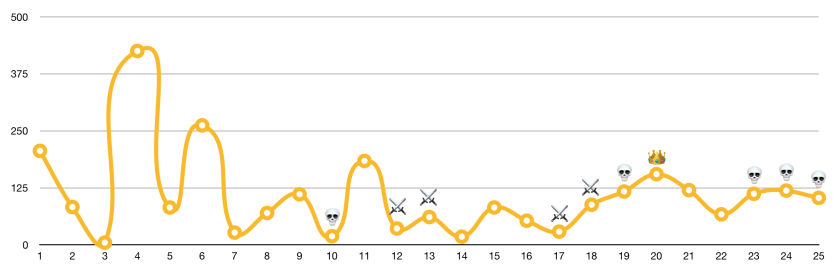
A Level pre-Easter mock assessments next week, and it struck me that amongst all the resources I had curated or created for my students, we didn’t have a decent synopsis of Edward II, for those who can never quite remember the story, or what happens when.
I had a train journey in front of me. What else could/would I do?
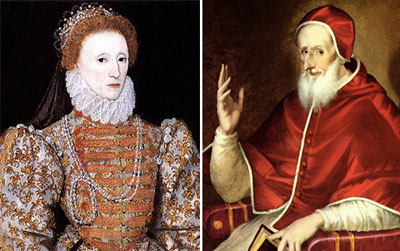
February 1570: in the blue corner, Elizabeth I; in the red corner, Pius V …
Commence au festival, as the Joker might say.
Ponytail Shakespeare read-through – King John, Act III
Continue reading “PTS 13/080: Remind me: who’s in charge here?”

King John, Act I
Having broken out of my Romeo and Juliet-induced enervation, I approached King John with a sense of excitement bolstered by my positive experiences with the Henry VI plays. Unusually, maybe impatiently, I skipped my Arden’s introduction and got stuck in after finding these hopeful signs elsewhere:
“a neglected play about a flawed king” [a]
and
“King John has all the beauties of language and all the richness of the imagination to relieve the painfulness of the subject.” [b]
So, what did I make of Act I?
Telling stories ABOUT stories seems to be my stock-in-trade when it comes to teaching Shakespeare.

Unusually, I’m going to start with the quotation of the week, from Stephen Greenblatt, rather than work towards it:
Humans cannot live without stories. We surround ourselves with them; we make them up in our sleep; we tell them to our children; we pay to have them told to us. Some of us create them professionally. And a few of us – myself included – spend our entire adult lives trying to understand their beauty, power, and influence. [a]
An almost ascetic book haul this time out …
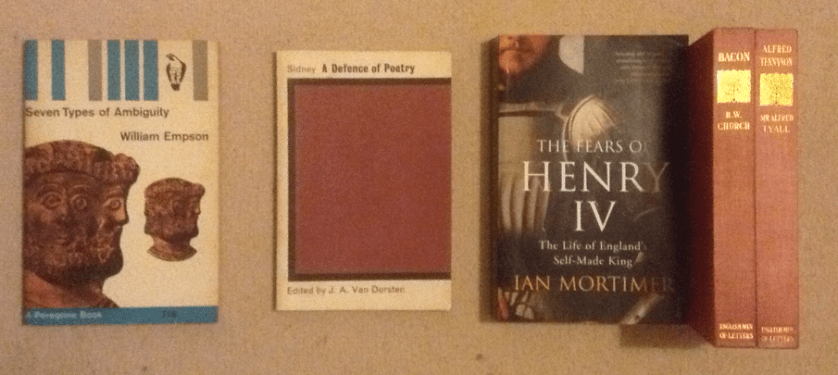
Sure, it’s only a week away from school, and I ought to be able to control myself. Many of you will also have a handle on the state of my bookshelves – I have no space for these, and yet. Half-terms are an opportunity to catch breath in more ways than one.
Some would suggest I oughtn’t to have bought anything; I like to think of this as a fairly restrained Book Haul, all sourced from the second hand bookshop about 300 yards from ‘her place’. So, what and why …
It’s no wonder we love soliloquy …

Regular visitors know that I teach Richard III and Edward II at A Level – coincidentally, plays which seem to have appeared within months of each other, in or around 1592. Marlowe doesn’t get discussed much in the circles I move in online, and Edward II often feels even more overlooked – so when someone wanted to talk about the differences between Kit and Will on /r/shakespeare (after watching a performance of Tamburlaine), I couldn’t resist diving in. Here’s an edited extract of what I said:
Richard II = Edward II = Prospero = Duke Vincentio = Henry VI = every useless boss you have ever worked for,
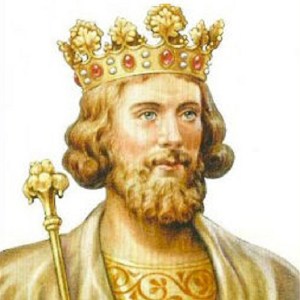
Richard II appears on my reading list for Edward II each year. It’s not just me – this is what Jonathan Bate, who I recently gushed about, has to say:
Richard II’s relationship to Edward II is so obvious that it is not very interesting. The structure of the two plays is identical: the King is surrounded by flatterers and pitted against an assemblage of nobles with vested interests of their own, then isolated and uncrowned, stripped of his royal identity, thus forced to discover his inner self by means of a supple, reflective soliloquy delivered whilst humiliatingly in prison. In each play the Queen is pushed to the margins in part because of the king’s homoerotic leanings. Marlowe is bolder than Shakespeare in his explicit portrayal of the homosexuality and his neat device of joining the Queen with the rebels in revenge. [a]
It should be easy to find something in Richard which’ll look familiar to my Edward students, right? Let’s have a go …
Studying a History play? Look for the playwright’s sources …
 My Marxist critical inclinations – that a text can’t be read in isolation from the contextual crucible that created it – get pretty much free reign when it comes to teaching Edward II. For the OCR A Level course, my students need to compare Marlowe’s drama to Tennyson‘s monodrama, ‘Maud‘ and, get this, 50% of the mark is context (that’s AO3, troops).
What, exactly, is context? I’d suggest that for both texts, maybe all texts, context is usually a mix of two things:
What, exactly, is a text?

As the school year commences, for teachers if not students, welcome to the first page of my main copy of Marlowe‘s Edward II. [a]
Why am I showing you this?
Continue reading “Quotation of the Week (#55): 03 September 2018”
 The Boar's Head, Eastcheap