She sounded unimpressed. Hurt, even. I backtracked swiftly.
I live alone, and lead quite a solitary existence, truth be told.
But, and I suspect it’s a sign of madness, like JF Sebastian in Bladerunner, I have a number of inanimate buddies who I’ve named. I even say hello to them when I get in, sometimes, in a post-post-post-modern, ironically jovial way. Take my fridge, for example …
As Alice might say: ‘de tongues of de mans is be full of
deceits’
Love’s Labour’s Lost, Act II
‘We could do with a shot on goal, John. The game’s mostly being played in the middle of the pitch’ …
Our Princess arrives, and immediately impresses. In fact, she reminds me of my girlfriend: scarily competent, impervious to flattery (no, really), and icily, frustratingly logical at times.
I wonder if there was a time when, at least as an adult, the name Germaine Greer was unknown to me. Yet this slim volume, picked up in the last mad pre-demolition trolley dash round our old sixth-form building almost a year ago, is my first reading of any of her works. I feel a bit embarrassed about that.
Lesson 1: Books, no matter how interesting, are not a girlfriend substitute …
‘You lay off that pet shop dame. Women weaken legs!’ ~ Mickey (Burgess Meredith)
PTS read through: Love’s Labour’s Lost, Act I
It feels appropriate to arrive at this play in the month when it seems you’re not a functioning member of society if you don’t add some kind of punishing denial to the post-Christmas blues: Dry January, the unappetising-sounding Veganuary, or in my case, the Walk 1,000 Miles in 2018 challenge (already behind schedule). Personally, I think we’ve enough to cope with, waiting for things to warm up and the nights to become appreciably longer.
Nevertheless, this is how the play opens – with a preposterous resolution by the foolish King of Navarre and three of his intimates to ‘abjure the rough magic’ of the fair sex. Unlike Rocky’s trainer Mickey, they’re worried about the intellectual rather than physical effects that women may have on them
I give them a maximum of ten minutes, stage time …
“This is all the UK has to show for itself. The situation is urgent. Please think of others far worse off than you and give generously”
For those who don’t know Mr Woolfe, he was hovering on the edges of glory at UKIP for a few years, challenging for the ‘leadership’ at one stage, until leaving in high dudgeon after a classy physical altercation with a colleague, and now standing as an ‘Independent’. UKIP is, for the uninitiated, the United Kingdom Independence Party – a political party of xenophobic, borderline racist, swivel-eyed loons who have done as much as anyone else to get us into this desperate Brexit mess.
Mr Woolfe is currently one of my MEPs (Member of the European Parliament). I didn’t vote for him. But tonight, to my shame, he represents me.
Not everyone gets their just desserts as our RomCom ends …
Do I know you?
The Comedy of Errors, Act V
Shakespeare has plenty to do in the 400-odd lines of Act V. The general confusion needs to create a crisis before we can have our happy ending – in this case, perhaps an equivocal, unsatisfying one, but more on that later.
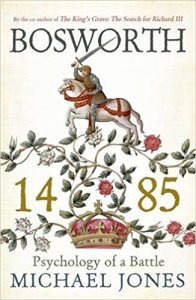
Michael K Jones, 1485: Bosworth – Psychology of a Battle (John Murray: London, 2014)
My hopes for this book weren’t high, having bought it for £2-99 from one of those small discount bookstores that seem to defy all logic in staying afloat. I’ve been pleasantly surprised: Jones has something different to say, and he argues it clearly and persuasively.
One of the things he looks at is the demonisation of Richard, asking if it isn’t just a little over the top. If so, why?
Antipholus (E) is NOT a twenty-first century role model – but was he a sixteenth-century one?
… but truly two.’ Robert Louis Stevenson, The Strange Case of Dr Jekyll and Mr Hyde.
PTS read through: Comedy of Errors, Act IV
In 2018, the notion of what it means to be a ‘man’ feels ever more opaque, with behaviours and attitudes being scrutinised as never before, perhaps. As a gender, we sometimes appear confused about the path we ought to take to find a satisfying and yet socially acceptable direction or self-definition.
Maybe it was ever thus.
In yesterday’s post on Macbeth I touched upon the fragility of our hero’s notions of himself when his masculinity was challenged by his wife. Macbeth is largely a play about what it means to be a man, but that’s way down the line in terms of my reading schedule. Reading Act IV of Comedy of Errors felt like one of those non-comic interludes towards the end of plays like Much Ado About Nothing, and instead of laughing, I found myself thinking about what Antipholus(E) implies a ‘man’ should be. It’s not an attractive picture …
Can I REALLY be an apologist for Macbeth? I think so.
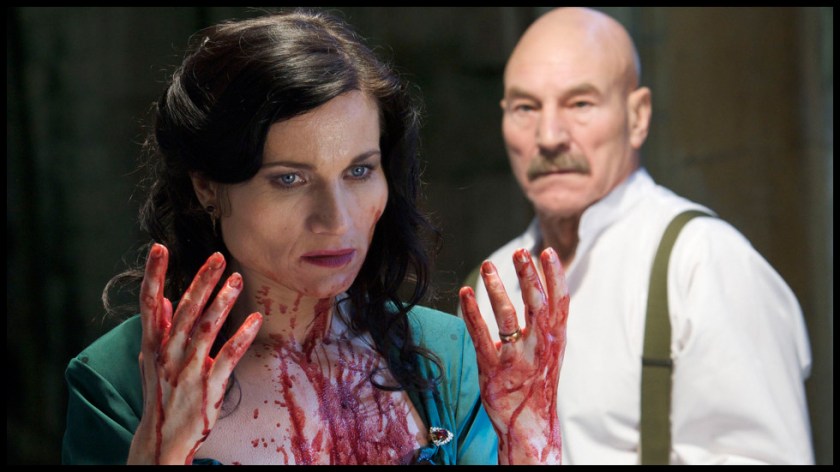
Kate Fleetwood and Sir Patrick Stewart as the happy couple …
“Something something isn’t Macbeth a villain!?!?!? something something.”
This is someone’s response to my suggestion that Macbeth (and, incidentally, his wife) is one of Shakespeare’s most ‘memorable’ characters. The ‘something’s are their words.
It set me thinking … IS he a villain, or simply a victim? Can I really be an apologist for him, I asked myself?







 The Boar's Head, Eastcheap