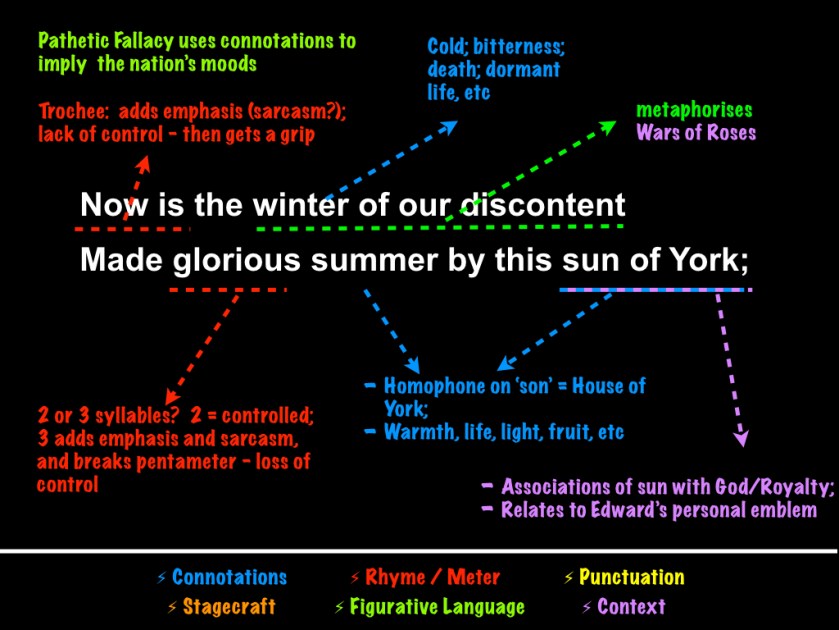
PTS 12/071: Choose Life!

‘Why would I bother watching Titanic, when I know how it ends?’ Silence …

BH trainspotting_uk

Ponytail Shakespeare read-through.  Romeo and Juliet:  Prologue

As a trainee, I remember ‘inheriting’ R&J from the usual teacher on placements. Twice.  And I vividly remember teaching the Prologue to a top set of smart, welcoming, wonderful students.

This was the class that christened Romeo the ‘pervy monkey boy‘ after watching Zeffirelli‘s interpretation of the balcony scene.  Thanks, Hannah – I will never forget that.  They’re also the bunch that did the ‘Mean Girls‘ recreation of Act III, scene v.  They made ‘fetch’ happen!  So much for ‘Two households, both alike in dignity‘ …

Despite the brilliant memories, I wonder if it’s significant that I have never, since, opted to teach the play, now that I am largely in charge of my own destiny?  And for PTS purposes, what can we, can I, pull out of these fourteen lines that hasn’t been said before over the last 400-years?

Continue reading “PTS 12/071: Choose Life!”

Forensic Friday (#03): RIII I.iv.180-183

It’s dawning on Clarence that he won’t talk his way out of this one …

“Do you do ‘PEEFE’* on Saturday nights, Sir?” one wag asked me, to general titters of amusement in C5.

‘Why not?  It’s fun.’ I replied.  And it is.  So why not?

Why not, actually, spend some time thinking again about RIII, I.iv?  Thinking about a grown man who has such a terrifying nightmare that he asks another to sit with him whilst he tries to get some sleep.  About a man desparately pleading for his life in every way he possibly can (see the Blues Brothers, above), when faced with two murderous executioners.  Much more fun than Love Island, surely?

Continue reading “Forensic Friday (#03): RIII I.iv.180-183”

Forensic Friday (#02): RIII I.ii.107-109

Don’t just talk the talk – walk the walk, Sir!

Subtitled: This Charming Man

BH the smiths

What kind of teacher asks their students to do something they wouldn’t do themselves?

My latest Y12 Homework task was titled, yes, This Charming Man – students were asked to analyse the exchange between Richard and Anne in Act I scene ii of Richard III.  Those who were feeling a bit flash were challenged to get in as many song titles as they could from The Smiths discography.

Continue reading “Forensic Friday (#02): RIII I.ii.107-109”

A Restless Ecstasy …

Here’s looking at you, H …

BH RIII I i 1.001

So.

It’s been a long, hard, day.  No, really!  In amongst the pre-school meeting; the marking; the trying to keep your errant Year 11s just on this side of hysteria, given they have their second English Lit exam on Friday; the data (two classes’ worth, by lunchtime, thanks very much); the lunchtime storytelling club for younger pupils; the broken photocopiers; and the almost insignificant matter of actually teaching,  you need an oasis of calm.

Or two …

Continue reading “A Restless Ecstasy …”

Crimes Against Shakespeare 011: beware Shakesphobia

Don’t Panic, as Douglas Adams might say. Together we can beat this awful disease.

BH shakespeare-signature-shutterstock2

This is a PUBLIC HEALTH WARNING brought to you by the Boar’s Head, Eastcheap.

There is a deadly, debilitating disease sweeping schools in the UK.  Parents, teachers, and especially students need to be informed.  Many people do not realise they have it until it is too late.  Treatment can be lengthy, and painful, and some patients (err, I mean students) never recover.

Continue reading “Crimes Against Shakespeare 011: beware Shakesphobia”

Quote of the Week: 12 March 2018 (#32)

It’s a wonder Will didn’t end up in prison, when you think about it …

BH shakespeare censorship
image:  The British Council, Index on Censorship

This week’s quotation is from Germaine Greer, Shakespeare (Past Masters series), (Oxford: OUP, 1986), p.75

Classroom experience tells me that [massive generalization] today’s students are disinclined to think for themselves [/massive generalization].  It’s part of the resistance to Shakespeare that seems to be coded into some pupils’ DNA (and another day I might talk about the ‘generational’ thing), but we see it with other texts.  A while back, in Manchester, I taught the short film ‘The Virus’ – which I personally think is excellent:

– but it was met with howls of anger (only slight exaggeration) from students who couldn’t work out what had happened, why, and what might happen next.  Watch the film, if you have under ten minutes, and then ask yourself if the main character is alive or dead at the end.  Then, ask yourself why or how the answer couldn’t be obvious to 14/15 year-olds.  This happened with TWO classes.  I wasn’t just taken aback:  I was worried. Not least because they thought it was ‘rubbish‘ because they couldn’t figure it out.

To be fair, this probably isn’t new – had my students been alive at the time, and in possession of the attention span required to read it, they would have been part of the contemporary outcry over the ending to Great Expectations.  But Dickens‘ audience wanted their theories confirmed or refuted.  In 2018, it just seems endemic that people have no theories.  They just want to be told what to think … and that scares me.

Who do I blame?

Continue reading “Quote of the Week: 12 March 2018 (#32)”

PTS 10/058: Eat up your Shakespeare

Putting Shakespeare in students’ mouths is often as much fun as feeding a baby – the faces they pull!

BH Shakespeare Food
image (C) Francine Segan

A Midsummer Night’s Dream:  Act I

Shakespeare’s language lives in the mouth, not the ears or eyes.  It needs to be tasted, and one of the advantages of living alone is that I can pace up and down my flat’s lengthy corridor reading tricky lines out loud, or just playing with the inflections of favourites:

I wasted time and now doth time waste me.

I WASTED time and NOW doth time waste me.

I wasted TIME and now doth TIME waste ME.

And so on, like the celebrity skit in the BBC’s Shakespeare400 celebration.  You get the picture.

If it needs to be tasted, it also needs, I suppose, to be CHEWED.  That’s what we often do in the classroom …

Continue reading “PTS 10/058: Eat up your Shakespeare”

Quote of the Week: 12 February 2018 (#28)

Should we pay more attention to James I before he became King of England?

BH cogwell james i

Thomas Cogswell, James 1:  The Phoenix King (Penguin Monarchs series), (Allen Lane:  London, 2017)

Studying or teaching Shakespeare’s plays, the figure of Elizabeth looms in the background, like the spectre at the feast.

We see it in the ever-present censorship, in the light of the Treasons Acts in 1571 and 1581, outlawing public discussion of the succession.  Or, more positively, in the ‘Gloriana’ cult that produced works like Spenser‘s The Faerie Queen, and flattering nods to Elizabeth wherever you look – like links between her and Theseus in A Midsummer Night’s Dream.  We see it in her discomfort with comparisons to Richard II, and the propagandic lionization of Henry VII.

Reading Cogswell‘s short, sympathetic biography has made me reassess the extent to which we / I ignore James until the succession question becomes absolutely critical.

Continue reading “Quote of the Week: 12 February 2018 (#28)”

Crimes Against Shakespeare 010: On ‘Dumbing Down’

This has been on my mind for a while …

BH dumbing down

This is a long read – I say that on a blog where posts often hit 1,300 words, against ‘accepted wisdom’ – so apologies in advance.  YOUR blog is your blog; my blog is MY blog, and I write for catharsis and as a kind of journal, not ‘popularity’, ‘followers’, or ‘influence’.  I was tempted to temper my words with a gallery of pictures, but that didn’t feel right, either.  This post feels a little more personal than most.

In spite of, or maybe because of, constant trawling for Shakespeare-related content, I have only just found this.  Last April, Peter Marks wrote a piece for The Washington Post  (link below) suggesting that Americans are too ‘intellectually lazy’ to appreciate Shakespeare, and fearing for the future popularity of the plays.  My immediate response was ‘you think it’s bad in the US?  Try over here, where Shakespeare was born!’

Continue reading “Crimes Against Shakespeare 010: On ‘Dumbing Down’”

Quote of the Week: 01 January 2018

Is royal blood THINNER than water?

pollard_cover

Pollard, AJ:  Edward IV, The Summer King (Penguin Monarchs) (Allen Lane:  London, 2016)

It happens in the best of families.  Royalty is often an accident of birth, and doesn’t guarantee fitness for rule, as we’ve seen in the exploits of Henry VI and Edward II – weak sons of strong fathers.

Continue reading “Quote of the Week: 01 January 2018”