“This is all the UK has to show for itself. The situation is urgent. Please think of others far worse off than you and give generously”
For those who don’t know Mr Woolfe, he was hovering on the edges of glory at UKIP for a few years, challenging for the ‘leadership’ at one stage, until leaving in high dudgeon after a classy physical altercation with a colleague, and now standing as an ‘Independent’. UKIP is, for the uninitiated, the United Kingdom Independence Party – a political party of xenophobic, borderline racist, swivel-eyed loons who have done as much as anyone else to get us into this desperate Brexit mess.
Mr Woolfe is currently one of my MEPs (Member of the European Parliament). I didn’t vote for him. But tonight, to my shame, he represents me.
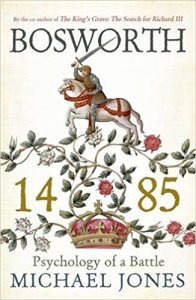
Michael K Jones, 1485: Bosworth – Psychology of a Battle (John Murray: London, 2014)
My hopes for this book weren’t high, having bought it for £2-99 from one of those small discount bookstores that seem to defy all logic in staying afloat. I’ve been pleasantly surprised: Jones has something different to say, and he argues it clearly and persuasively.
One of the things he looks at is the demonisation of Richard, asking if it isn’t just a little over the top. If so, why?
The more things change, the more they stay the same …
Neale, JE: Queen Elizabeth I (Pimlico: London, 1998)
Once again, I’m minded to say that we continue to study EMP Literature because whilst times and technology have undoubtedly moved on, human attitudes and the situations we face remain broadly the same.
Endemic Xenophobia? Check.
Effemination of rival men who dress too well? Check.
Aristocratic disdain for ‘upstarts’? Check.
‘Plus ça change, plus c’est la même chose,’ asJean-Baptiste Alphonse Karr(another foreigner*, dammit!) might say …
I know you all, and will awhile uphold
The unyoked humour of your idleness:
Yet herein will I imitate the sun,
Who doth permit the base contagious clouds
To smother up his beauty from the world,
That, when he please again to be himself,
Being wanted, he may be more wonder’d at,
By breaking through the foul and ugly mists
Of vapours that did seem to strangle him. (PRINCE HAL: 1 Henry IV. I.ii)
I’d love to ascribe these lines to our leaders, but I reserve them for myself today …
Are our masters “fettered with chains of gold”? Sir Thomas Wyatt (1503-42) thought so. Perhaps we could ask Theresa May …
Andrew Sanders, The Short Oxford History of English Literature (Oxford University Press, Oxford, 2004)
(A book I rescued – for under 50p – from a Greater Manchester library who had withdrawn it because it was not being taken out …)
I’m going to step back a little to someone who operated before Shakespeare lived, but will have influenced the development of poetry up until our boy arrived on the Shake-scene.
Claiming ‘Shakespeare was this or that’, or worse, ‘Shakespeare did not write the plays’, does NOT entitle you to a mic-drop. It just shows your intellectual bankruptcy …
Siobhan Fahey and Marcella Detroit – women I fancied (at 19) as much for their deranged, dangerous, deep and devil-may-care personas as their looks.
I’ve written elsewhere about the Rally of Revenge – about my unease that once you abandon all faith in ‘due process‘ or ‘justice‘ (either earthly or divine); once you understand that inequality is endemic, you have nothing left to lose – if you are already losing – so keep raising the stakes until someone has to leave the game. If it’s uncomfortable, perhaps it’s also sometimes necessary, to affect change of a fundamentally broken system. You might not see the benefits yourself. Hey, if you have to leave the game, then so be it: losing can become preferable to playing along, eventually.
There are always other games, other paths, whilst we are still alive – experience has taught me that, even if Shakespeare hasn’t.
And that’s where I find myself, professionally, this weekend. Approaching change, but ready for it, and maybe, in some ways, relieved that an unhappy stasis has broken. There are always other games.
There is a third way – for revenge – I’ve not written about before. The poet George Herbert(1593-1633) suggested that:
Living well is the best revenge.
And I’ll embrace and adapt that, in a ‘standing on the shoulders of giants‘ sense.
Living well equals happiness. LAUGHTER is the best revenge.
Today, I intend to laugh at someone. Long, and hard.
Flatterers … are destined to mud-wrestle each other in a lake of diarrhoea … representing the crap they spoke whilst alive, I suppose!
The ultimate HAMLET tee-shirt?
Subtitled:Big Mouth Strikes Again(The Smiths – my students will know why, today of all days)
This article was written for a forthcoming in-house newsletter/magazine. First, hopefully, in a series of articles (Cultural Capital) about influential, dare I say essential works that our students need to get under their belts. I set myself a STRICT word-count of 750, including quotations but excluding titles and references, tried to avoid being too professorial, and I’ve prioritised other texts related to what I’ll be teaching as part of the OCR A Level Engish Literature course. If I’m spared 😉
—
Inferno is a valuablesource of AO1 and AO3, people. This won’t replace you reading the original, but it might at least persuade you to give it a go.
Next up? James I‘s Daemonologie, Machiavelli‘s The Prince or The Book of Genesis: open to suggestions …
—
[…] Midway on our path in life,
I came around and found myself searching
Through a wood, the right way blurred and lost.
I know the feeling. More importantly, so begins Dante’s Inferno, the sexiest-titled poem no-one’s read.Perhaps only at a certain age do you start asking Really Big Questions:‘What am I doing with my life?What’s the point?What’s left?’Tennyson’s like a dog with a bone on this.Ponytail Shakespeare readers – you’re fed up of hearing this sort of thing from me.
The most important question, though, is surely ‘what’s next?’
Anything other than modern ‘exclusivity’ could mean demotion and starvation at best, or – more likely – imprisonment, exile, or execution.
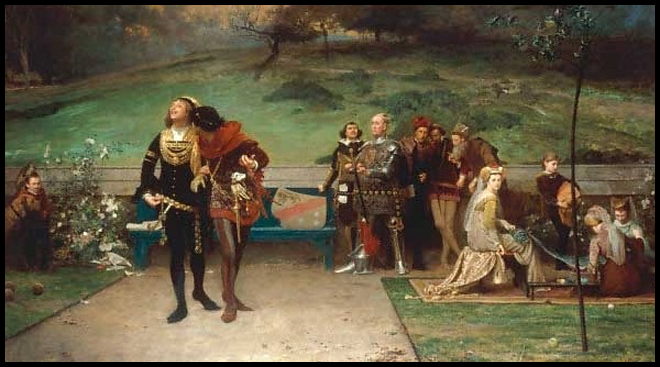
Painting by Marcus Stone: Edward and Gaveston frolic in front of Isabella et al …
CLASSROOM BASED ASSESSMENT: In Edward II, love is invariably possessive. Discuss.
Weightings:AO1 (25%); AO3 (50%); AO5 (25%)
God, I hate this question.
One of the things that I got from my teacher training, back in the day, was that if you asked a poor/stupid/inaccessible question, you only had yourself to blame for crap answers. This is an OCR question – at least the students get a choice of six to answer for their final exams. But for reasons beyond my ken, or immediate power to change, it is our first CBA on Edward II. It also comes too early in the course for people who were in school uniform less than 6 months ago to be asked to deal with AO5, if you ask me. They were being constantly drilled in AO2, and for this essay, it’s not required …
But enough whinging. In the spirit of never asking people to do something you wouldn’t do yourself, here’s a model answer for my class to play with. I tried to do this in the same conditions they were asked to do it in, without any ‘cheating’ on my part.
IF THIS IS THE FIRST TIME YOU’VE HAD A LOOK AT ONE OF MY ESSAYS, PLEASE CLICK HERE FOR THINGS YOU NEED TO KNOW.
Presuming someone’s guilt can create a dangerous reaction …
The Gunpowder Plot: The Narrative of Oswald Tesimond alias Greenway (ed. Francis Edwards), (The Folio Society: London, 1973)
Given the date, and the current BBC production of ‘Gunpowder‘, currently horrifying the squeamish across the country, it seems apt to take a second quotation from this book – the first is here.
Christ, this is IT […] THIS is why I do it. All of it.
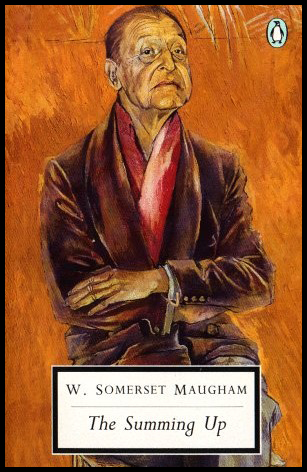
W. Somerset Maugham, The Summing Up (Penguin: London, 1992)
Today’s post is all about one simple fact: the world-wide-web existed centuries before the Internet. Before electricity, in fact. And I want you to plug into it.
I find it apposite, and slightly ironic that writing about Shakespeare, and without any deliberate choice on my part – I promise you – I’m listening to the Tron Legacy soundtrack as I type this. My other literary love is Science Fiction, and again, the point I’m making relates to that intoxicating cocktail of the 16th and 26th centuries, with a dash of the present thrown in.


 Neale, JE




 The Boar's Head, Eastcheap