For a perfectionist, it’s an opportunity: time to produce something better than ‘good enough’ …
Sun, sun, sun, here it comes …
It seems like years since it’s been here. [a]
So many people seem to resent our summer holiday. They bemoan having to take responsibility for their own offspring (my favourite pet peeve); whine about the cost of holidays; whinge about the number of tourists clogging their area (without appreciating how their local economy depends on that tourist pound, or how often they are the problem in other parts of the country).
Hot ice and wondrous strange snow: the appetite for articulation …
Destination 1592 … [a]Frequently, I ask my class to step into the time machine and join me back in 1592.
Why then?
Conveniently, it’s as close as we can get to dating both Richard III and Edward II, my Key Stage 5 texts. The other plays I teach at the moment – Much Ado About Nothing and Macbeth – follow on from here.
This period was a crucible in which Drama as we know it was being born, alchemically transmuted from the didactic Morality Plays into something fresh and exciting. With my Marxist critical hat on, if we can understand the contextual elements poured into that cauldron, we can better appreciate and analyse the resultant heady brew.
Marlowe was never going to fit in. In some ways I wish he hadn’t tried so hard – he would have lasted longer.
What?
‘We don’t like mavericks here …’
– is what I was told some years back at my first school. My first school, just to be clear …
It’s not a default position, I promise you – I honestly don’t aspire to be a maverick. It’s simply about my always bearing in mind the attributed words of Einstein: the definition of insanity is doing the same thing again and again and expecting different results. So if it demonstrably doesn’t work or doesn’t make sense, you need to find someone else, if you want blind obedience. How do we improve, otherwise? Plus, my teaching mentor gave me advice I’ve never forgotten, and which has served me well (and my students, if results are anything to judge by*). We might paraphrase it as: ‘As long as you know where should be taking the students, don’t stress about abandoning the lesson plan and getting there via another route.‘
So, admittedly, I can be a:
maverickˈmav(ə)rɪk/ noun
1. an unorthodox or independent-minded person.
But, surely, no SURELY, this what we aim to foster in our children (what actually we reward in the subject: critical, evaluative thinking and independence of ideas – those terms are on the markschemes, at the top end) … right? Or does education exist to train people into unthinking passivity?
Students laugh when they hear it, but Anne was in deadly earnest …
We have hedgehogs.
I say ‘we’, but I’m appropriating the cute nocturnal visitors at my Snowdonia home (also known as ‘her place‘) …
Having spent most of the week camping in the back garden – yes, by choice – I’ve become a lot more familiar with their comings and goings: their enthusiastic crunching of mealworms (these are spoiled, and resolutely ignore the slugs they are supposed to be eating – I’ve seen them nudge slugs aside with their snouts!); their irritated huffing and snorting when a rival appears at bowl number two, all within a couple of feet of my head.
Which, of course, makes me more sensitive to the hedgehogs – just three of them* – in Shakespeare …
It wasn’t till I got to University that I came across Malcolm’s ‘king becoming graces’ in Macbeth. I thought them startling – an almost impudent challenge to James I about what the country expected from their new monarch, in a play which, I’m increasingly convinced, is all about what it means to be a ‘man’:
Mistrust might be too strong a word, but there was always a youthful rebellious streak in me (Catholic-educated in what was at the time a pretty Catholic town), pushing against what I increasingly viewed as the bastard child of The Party in Orwell‘s Nineteen Eighty-Four and a medieval Ponzi scheme. The Catholic hierarchy increasingly personified notions of hypocritical middle-men, ‘eternal life’ assurance brokers, gatekeepers against the hereafter who would feed on the poor, vulnerable and frightened, whilst actually allowing anyone through, if the price was right.
Finally, I officially ‘fell out’ with God in a completely predictable spat – over bureacracy, not the Bible; red tape, not redemption; compliance, not communion …
BOTTOM: I will discharge it in either your straw colour beard, your orange-tawny beard, your purple-in-grain beard, or your French-crown-colour beard, your perfect yellow. [a]
Although The Guardian confidently proclaimed we’d reached ‘peak beard’ two years ago – in fact exactly two years ago today [b] – I stopped shaving before Christmas. I’m far from a fashion victim: this was initially sheer laziness (I loathe shaving); now increasingly compounded by curiosity about exactly what I might grow. After nearly thirty years of a more-or-less maintained goatee, I’ve gone wild.
It’s a work in progress (and had to survive a pre-Portugal pruning by She Who Must Be Obeyed), but I’ve ended up with a hybrid: think the hirsute love-child of Hemingway and Fidel Castro … the addition of a very disreputable cap during my Easter hols jolly to the Algarve has added, I like to think, a revolutionary aura to the whole thing. Plus, some students have given it a name of its own, like a stray dog. So, the beard is staying – for now.
Naturally, this started me thinking about beards and the Bard …
Niccolò Machiavelli: The Prince, (transl. George Bull, ed. Anthony Grafton), (Penguin Classics: London, 2003). e-book ISBN: 9780141912004 (£2.99)
– – –
Niccolò Machiavelli … the name has a seductive musicality, like all the Devil’s best tunes, and in Italian, ‘Il Principe’ uncoils like a snake, before hissing and then biting. This, his most famous work, has insinuated its way into our psyche until ‘Machiavellian’ has become part of a sinister cabal of authorial-adjectives including ‘Orwellian‘, ‘Lovecraftian’ and ‘Kafkaesque‘.Yet how many people appreciate its true meaning, having read ‘The Prince’?Is its reputation merited?Is it a useful, topical read, or a dusty, centuries-old curiosity?
‘On Brexit, and Ignoring the Advice of Uncles’, as Montaigne might have written …
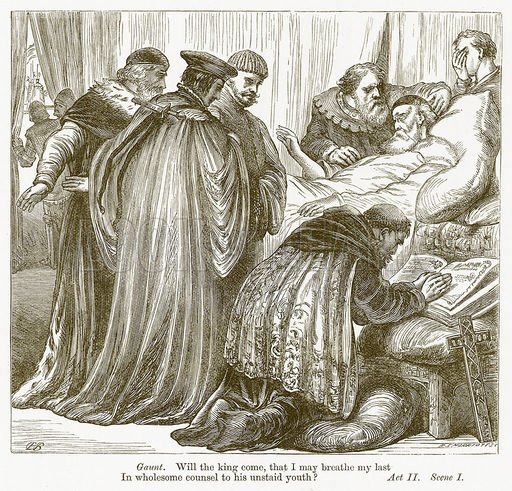
PTS read-through: Richard II, act II
Richard II plays against the backdrop of an enormous cosmic clockface. Our poetic but ineffective, spiteful monarch ends act I cynically hoping to arrive too late; he begins act II suffering the consequences of being early, getting an earful from his uncle.
What Richard does miss, though, is Uncle Gaunt’s remarkable crie de couer on the state of the nation. It’s an interesting, beautiful swansong, the breathless anaphora creating a crescendo of patriotic fervour – but I have three issues with it.





 The Boar's Head, Eastcheap