

To begin, a little quiz. What connects the following texts?
- Ian McEwan: On Chesil Beach (2007)
- Alfred, Lord Tennyson: ‘Maud’ (1855)
- Christopher Marlowe: Edward II (1592)
- William Shakespeare: Richard III (1592), and
To begin, a little quiz. What connects the following texts?

Will the real Richard III please stand up?
The differences between our screen Shakespeares can be easily as great as those between Thomas More‘s view of him pitched against Sir Horace Walpole in the fascinating book, The Great Debate.
This essay explores how Shakespeare’s script has been interpreted to portray our tragic hero …
subtitled: ‘Sir’s rule number 1‘ …

‘Who’s there?’
‘Nay, answer me. Stand and unfold yourself.’ [a]
Bernardo and Francisco have a point. The entire path of the scene is determined by who is on stage. Think of the ways the conversation could go if instead of Bernardo, another unknown Dane approaches Francisco’s guard-post, or one of Fortinbras’ troops.
From Hamlet to real life, and the idea of decorum – behaving or speaking appropriately to the circumstances and audience.
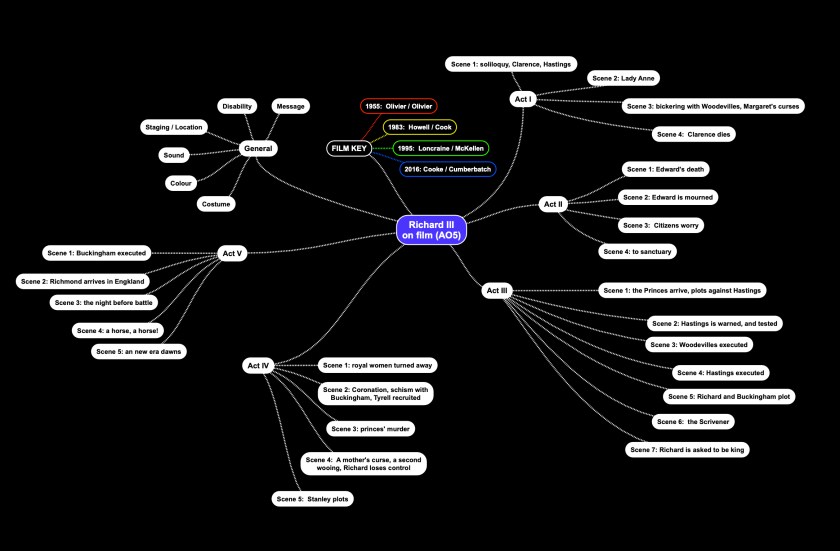
Welcome to my next stupidly ambitious project …
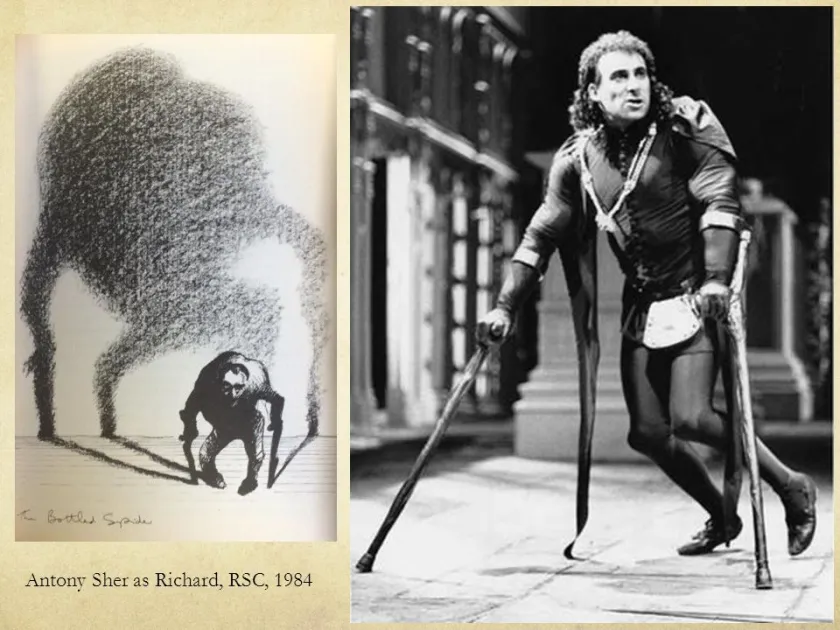
It’s nearly a year (where has the time gone?) since I last picked up a book and decided I’d love to get down the pub for a session with the author (and bear in mind I’m still not drinking: day 70 today). Imagine me, Anthony Sher and Michael Bogadanov setting the Shakespearean world to rights over a few scoops …

And we’re back with Forensic Fridays …
Partly because I’m teaching Richard III to a new A Level class, partly because my exam class will benefit, should they ever visit (you know who you are), and partly because yes, they are fun.
You can see the full rules here, but if you’ve been before, the task is to write a prize-winning forensic analysis of a very short extract in just 250 words, working to OCR’s mark-scheme in order to provide some models for my students.
In this passage, I returned to the dramatic moment when deposed Queen Margaret of Anjou, devastated by the killings of her son and then her husband (within 17 days, historically), calls down the heavens to curse Richard, Duke of Gloucester, who in the Henry VI cycle did what had to be done. It’s a very tense moment …
“this it is, when men are ruled by women” – or at least by their groins …

Although I’m never going to end up on stage, I often compare teaching to acting.
Non-teachers, think for a second: up to six performances a day, with audiences who require subtly different characterisations from you. (My timetable goes from Y12 to Y7 without interval on a Friday afternoon, for instance). That plus the teacher persona you can only shrug off when you’re safely indoors (because even walking down the street you end up intervening when you see pupils in uniform mucking about). To say nothing of the range of people you have to be – in five minute chunks – at Parents’ Evenings …
No wonder I’m perpetually exhausted.
But if I were asked to play a Shakespearean role, what would be my top three choices?
… is that the job is, frankly, shit. And that you have to be a shit to do it successfully.

PTS read-through: King John, Act IV.
If you’re not ‘born great’, if you want to achieve greatness, you have to put in the hours, right? Just think of the graft involved: wheeling and dealing; equivocating; making and breaking alliances; sucking up; marrying well (not, alas, for love); adding colours to the chameleon; changing shapes with Proteus; and generally setting the murderous Machiavel to school.
And for what?

February 1570: in the blue corner, Elizabeth I; in the red corner, Pius V …
Commence au festival, as the Joker might say.
Ponytail Shakespeare read-through – King John, Act III
Continue reading “PTS 13/080: Remind me: who’s in charge here?”
If there’s anyone more maligned than Greene who wasn’t actually a serial killer or worse, I’m struggling to come up with a name.

Although it increasingly appears to have been abandoned in the twenty-first century, conscience is everywhere in the late sixteenth. Hamlet, of course, blames it for his cowardice; Margaret curses Richard III with it; and it seems almost a rule that if you hire two thugs to carry out some dastardly act, one of them will prove reluctant …
It is also, it seems, only for the poor and the base – much like its cousin, Patience. Even in moments of classic anagnorisis, I’d suggest we scarcely see it in our tragic heroes – a subject for another post, perhaps.
Anyway, to Robert Greene …
 The Boar's Head, Eastcheap