Thankfully, we can’t have a third series of The Hollow Crown, but what about adaptations of the Roman plays?
If there’s one thing my (currently stuttering) Pony Tail Shakespeare read-through project has given me so far, it’s a greater love for the History Plays. Once the project is (eventually) finished, I’m looking forward to reading them again merely for pleasure.
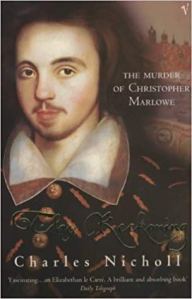
Our victim was brash, talented, and stabbed just above the eye before his 30th birthday …
Charles Nicholl, The Reckoning: The Murder of Christopher Marlowe (Vintage: London, 2002)
– – –
‘I am not trying to argue that Marlowe’s death has to have a meaning. My reading tends only to a more complex kind of meaninglessness than that of a ‘tavern brawl’.
Gifted, abominable, yet capable of producing ‘the mighty line’ …
Ben Wishaw and Karoline Herfurth in Tom Tykwer‘s 2006 film
It’s episode 52 – not a continuous year (the first post is here), but a year nonetheless, so I’m going to indulge myself a little this week. Will you be able to tell the difference, I hear you ask!
Bear with me whilst I tell you a story:
In eighteenth-century France there lived a man who was one of the most gifted and abominable personages in an era that knew no lack of gifted and abominable personages. His story will be told here. His name was Jean-Baptiste Grenouille, and if his name – in contrast to the names of other gifted abominations, de Sade’s, for instance, or Saint-Just’s, Fouché’s, Bonaparte’s, etc. – has been forgotten today, it is certainly not because Grenouille fell short of those more famous blackguards when it came to arrogance, misanthropy, immorality, or, more succinctly, wickedness, but because his gifts and his sole ambition were restricted to a domain that leaves no traces in history: to the fleeting realm of scent. [a]
‘You will, generally, be rewarded for originality, but the crazier your argument is, the better your reasoning should be’.
Originally intended as a confidence-builder for the chronically-tentative, it’s become a cliché in my teaching that ‘in English, there’s no such thing as a wrong answer’. Increasingly, though, and especially at A Level, I’m finding it necessary to qualify that empowering notion.Perhaps students were getting a little too emboldened, as we’ll see below.Just as Squealer in Animal Farm reminds us that ‘Some animals are more equal than others’, some answers are – obviously – better than others. [a]
Almost organically, as I refined the concept, it came to be known as The Continuum of Plausibility™.I’ve been using the term here, off and on, for a while now without properly explaining it, so here goes.
O, she doth teach the torches to burn bright! (I.v)
At some stage I might put together a Shakespeare calendar – dates (like many things in Shakespeare)are often sketchy and hard to pin down. Look at what he does to the History plays!
As far as birthdays go, we know that Cleopatra, and Cassius, kill themselves on their birthdays. But as far as I can tell, we can only wish one girl ‘happy birthday’ with any certainty …
Lou Reed had Donald Trump nailed as long ago as 1989, namechecking not just the POTUS but also his latest cheerleader, Rudy Giuliani, in his polemic track, ‘Sick of You‘, which also contains the following memorable and prophetic lines:
They say the President’s dead,
No-one can find his head,
It’s been missing now for weeks.
But no one noticed it!
Yeah, he seemed so fit …
Marlowe probably DID make a hazard of his head by easing his heart …
The more I read about Marlowe, the more I like and sympathise with him – arrogant, frustrated genius, malcontent, morally questionable, and attention-whore as he may have been. I sense a kindred spirit: my best friend would say the same about me – perhaps with a lot more arrogance and a lot less genius. As I get older, I like to think that my moral code is finally begining to crystallise, where it was entirely fluid 25 years ago, but then Marlowe never had the opportunity to mellow …
Increasingly, I see Marlowe as the kind of ‘mis-shape‘ Jarvis Cocker sung about in 1995:
Andrew Tiernan as Piers Gaveston: an unsettlingly naked, chittering demon, occupying Edward’s throne (Jarman, 1991)
Episode 6 of Forensic Friday – the rules are here for first-timers – effectively kicks off this summer’s likely obsession with Marlowe.
My OCR A Level students are not obliged to analyse Edward II in this way; perhaps they’ll wonder at the point of today’s exercise. The point is that you ought to be able to do this – and enjoy the process – for any text, people. We are, after all, archaeologists of the written word – this is what we do …
Anyway, here’s a tiny extract that speaks volumes about Edward II’s lover and their relationship …








 The Boar's Head, Eastcheap