The more things change, the more they stay the same …
Neale, JE: Queen Elizabeth I (Pimlico: London, 1998)
Once again, I’m minded to say that we continue to study EMP Literature because whilst times and technology have undoubtedly moved on, human attitudes and the situations we face remain broadly the same.
Endemic Xenophobia? Check.
Effemination of rival men who dress too well? Check.
Aristocratic disdain for ‘upstarts’? Check.
‘Plus ça change, plus c’est la même chose,’ asJean-Baptiste Alphonse Karr(another foreigner*, dammit!) might say …
We only want to be kings because we don’t fully understand what it involves?
Christopher Lee, 1603 (Review: London, 2003)
Not THAT Christopher Lee, obviously!
In class, we’ve seen it in Edward II and, I think, Richard III. There are hints of it for my younger students in Macbeth. But I see it everywhere: in Richard II, Henry IV,Henry V, Henry VI.
In Twelfth Night, Malvolio tells us:
“be not afraid of greatness: some are born great, some achievegreatness, and some have greatness thrust upon ’em” (II.v)
Quite simply, the message I consistently get from EMP plays is that greatness – in this case being monarch – is never, ever, all it’s cracked up to be …
“Don’t expect gratitude from anyone who makes it thanks to you”
Subtitled: The Curse of the ‘Without-Whoms’
Niccolò Machiavelli, Il Principe (The Prince) original publication 1532
This is close to the top of my list of for the Cultural Capital series – a short, highly influential read, freely available: something which, frankly, you ought to have read by the time you hit university – whether or not you are an English Lit student.It’s the kind of thing that certain people, in certain circles, will expect you to have a working knowledge of in the big bad world.
Anyway, to this week’s quotation.Consider the following:
Are our masters “fettered with chains of gold”? Sir Thomas Wyatt (1503-42) thought so. Perhaps we could ask Theresa May …
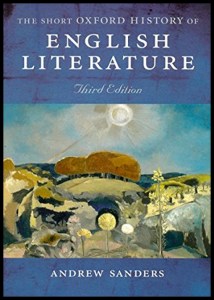
Andrew Sanders, The Short Oxford History of English Literature (Oxford University Press, Oxford, 2004)
(A book I rescued – for under 50p – from a Greater Manchester library who had withdrawn it because it was not being taken out …)
I’m going to step back a little to someone who operated before Shakespeare lived, but will have influenced the development of poetry up until our boy arrived on the Shake-scene.
Flatterers … are destined to mud-wrestle each other in a lake of diarrhoea … representing the crap they spoke whilst alive, I suppose!
The ultimate HAMLET tee-shirt?
Subtitled:Big Mouth Strikes Again(The Smiths – my students will know why, today of all days)
This article was written for a forthcoming in-house newsletter/magazine. First, hopefully, in a series of articles (Cultural Capital) about influential, dare I say essential works that our students need to get under their belts. I set myself a STRICT word-count of 750, including quotations but excluding titles and references, tried to avoid being too professorial, and I’ve prioritised other texts related to what I’ll be teaching as part of the OCR A Level Engish Literature course. If I’m spared 😉
—
Inferno is a valuablesource of AO1 and AO3, people. This won’t replace you reading the original, but it might at least persuade you to give it a go.
Next up? James I‘s Daemonologie, Machiavelli‘s The Prince or The Book of Genesis: open to suggestions …
—
[…] Midway on our path in life,
I came around and found myself searching
Through a wood, the right way blurred and lost.
I know the feeling. More importantly, so begins Dante’s Inferno, the sexiest-titled poem no-one’s read.Perhaps only at a certain age do you start asking Really Big Questions:‘What am I doing with my life?What’s the point?What’s left?’Tennyson’s like a dog with a bone on this.Ponytail Shakespeare readers – you’re fed up of hearing this sort of thing from me.
The most important question, though, is surely ‘what’s next?’
Anything other than modern ‘exclusivity’ could mean demotion and starvation at best, or – more likely – imprisonment, exile, or execution.
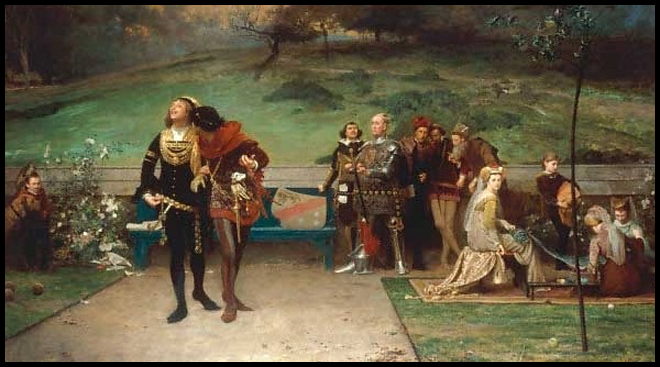
Painting by Marcus Stone: Edward and Gaveston frolic in front of Isabella et al …
CLASSROOM BASED ASSESSMENT: In Edward II, love is invariably possessive. Discuss.
Weightings:AO1 (25%); AO3 (50%); AO5 (25%)
God, I hate this question.
One of the things that I got from my teacher training, back in the day, was that if you asked a poor/stupid/inaccessible question, you only had yourself to blame for crap answers. This is an OCR question – at least the students get a choice of six to answer for their final exams. But for reasons beyond my ken, or immediate power to change, it is our first CBA on Edward II. It also comes too early in the course for people who were in school uniform less than 6 months ago to be asked to deal with AO5, if you ask me. They were being constantly drilled in AO2, and for this essay, it’s not required …
But enough whinging. In the spirit of never asking people to do something you wouldn’t do yourself, here’s a model answer for my class to play with. I tried to do this in the same conditions they were asked to do it in, without any ‘cheating’ on my part.
IF THIS IS THE FIRST TIME YOU’VE HAD A LOOK AT ONE OF MY ESSAYS, PLEASE CLICK HERE FOR THINGS YOU NEED TO KNOW.
Where Marlowe went when he should have been at Uni …
‘Gorgeous’ Georgius – with a beard any woman would want to lose herself in …
George Carleton, A Thankfull Remembrance of God’s Mercie (1630)
Much as I’d like a copy of this on the Boar’s Head Bookshelf, I’ve been playing with a facsimile copy I got from www.archive.org. I think it was mentioned in one of the episodes of BBC’s wonderful Shakespeare’s Restless World – which I recommend to anyone remotely interested in Shakespeare, Marlowe and their contemporaries.
As usual, I have one eye on anything that could be interesting or useful to my A Level students, so whilst I’d like to dwell on some of the pretty hilarious vitriol this man of the cloth (Bishop of Winchester, to be exact) reserves for the Catholic faith, I’ve something a little quotable for the students of Marlowe.
WE CANNOT, MUST NOT, WIPE ART WITH ANTI-BACTERIAL WIPES BEFORE ALLOWING THE NEXT GENERATION TO HANDLE IT …
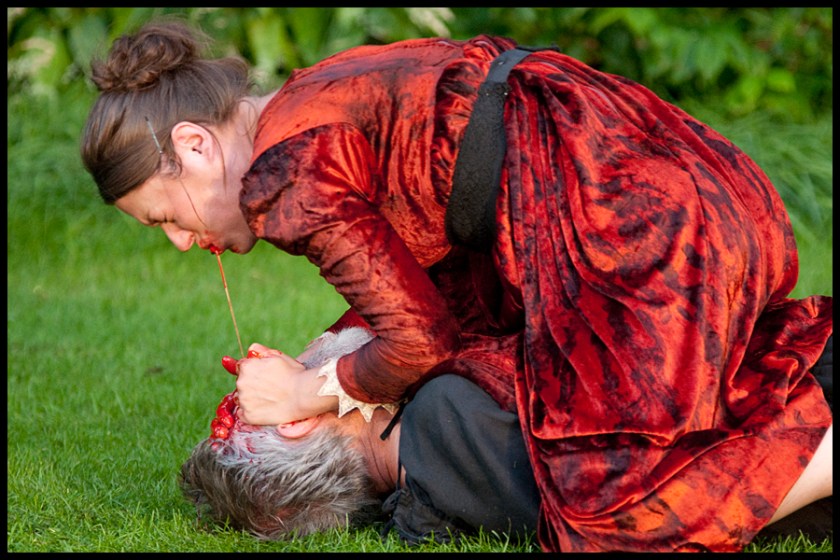
‘Out, vile jelly’: the blinding of Gloucester …
I took this picture – from King Lear – at the Cambridge Shakespeare Festival back in 2012. I often show it to pupils who try to tell me that Shakespeare is ‘boring‘. Or indeed I give them some of the plot details from Titus Andronicus that have caused such concern of late …
It’s taken me a little while to allow this one to sink in to the extent that it became a ‘crime’, but in the Dock, ladies and gentlemen of the Jury, I give you no less than the English Faculty of Cambridge University (or at least some members of that august institution) …
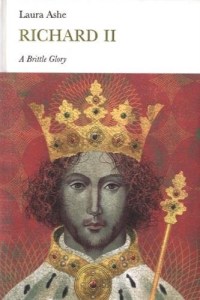
Laura Ashe, Richard II: A Brittle Glory (Penguin: London, 2016)
Emboldened by the excellent ‘Penguin Monarchs‘ volume on Edward II, I looked out which other volumes were available: the first that arrived in the post was this one.
Ashe‘s approach seems different to Given-Wilson‘s on Edward. Where he was reassuringly chronological, she deals with Richard’s reign (and I’ve seen this as a criticism of the volume online) thematically. It has, nonetheless, given me some useful insight into a king who I’ve always vaguely felt I owed a debt: I fell asleep watching Jeremy Irons in the title role – in Stratford, of all places – back in 1986/7. To this day, I blame the large lunch I had before the matinee performance …
Soon there won’t be much room for customers at The Boar’s Head.
… although it still isn’t keeping pace with my book buying. Buying books and reading books operate in entirely different dimensions, as my overflowing bookshelves will tell you. When I hit 100 books, which isn’t far off, if you include the Arden Third editions of the plays themselves, I may have to employ an orangutan to take the bookshelf into L-space. (GNUSir Terry Pratchett)

 Neale, JE: Queen Elizabeth I (Pimlico: London, 1998)
 Christopher Lee



 The Boar's Head, Eastcheap