Ken Dodd (and his infamous tickling stick): ‘I haven’t spoken to my mother-in-law in eighteen months. I don’t like to interrupt …’
You probably know my taste for puerile humour by now.
This joke (and there are many versions of it knocking around) has been a favourite since before I got married, a good twenty years ago. You can imagine how well it went down, the first time I used it on my (rather fierce) ex-mother-in-law. I received what we might call an ‘old-fashioned look’, with added chilli. Nowadays, poking fun at someone’s verbosity is also self-referential, because, yes, I unashamedly like to talk! In my defence, it’s because I ‘live’ in 1592.
‘You will, generally, be rewarded for originality, but the crazier your argument is, the better your reasoning should be’.
Originally intended as a confidence-builder for the chronically-tentative, it’s become a cliché in my teaching that ‘in English, there’s no such thing as a wrong answer’. Increasingly, though, and especially at A Level, I’m finding it necessary to qualify that empowering notion.Perhaps students were getting a little too emboldened, as we’ll see below.Just as Squealer in Animal Farm reminds us that ‘Some animals are more equal than others’, some answers are – obviously – better than others. [a]
Almost organically, as I refined the concept, it came to be known as The Continuum of Plausibility™.I’ve been using the term here, off and on, for a while now without properly explaining it, so here goes.
Should I oppose the slings and arrows of teaching the same thing year in, year out?
… THAT is the question occupying my thoughts at the moment.
No, this isn’t a Machiavellian masterplan for world domination (although see below, perhaps it’s just part of one).
What you see above is the bare bones of a 12-week (forty-eight lesson!) Scheme of Work on Julius Caesar that I’ve been toying with producing over the summer. I’m hoping for advice – not just on the skeleton of the scheme (although that would be highly appreciated), but on whether or not to bother …
Hot ice and wondrous strange snow: the appetite for articulation …
Destination 1592 … [a]Frequently, I ask my class to step into the time machine and join me back in 1592.
Why then?
Conveniently, it’s as close as we can get to dating both Richard III and Edward II, my Key Stage 5 texts. The other plays I teach at the moment – Much Ado About Nothing and Macbeth – follow on from here.
This period was a crucible in which Drama as we know it was being born, alchemically transmuted from the didactic Morality Plays into something fresh and exciting. With my Marxist critical hat on, if we can understand the contextual elements poured into that cauldron, we can better appreciate and analyse the resultant heady brew.
At 18, students ought to be able to handle History plays, but the exam boards don’t seem to like them?
Following my recent KS4 post, I extended my research to A Level – that is the exams taken by 18-year olds before they hit university. Again, I’d love to hear from students or teachers, especially in other countries. Here are a few thoughts of my own:
The keeper (left) tried to make himself look big, whilst under pressure from a swarthy Croatian defender, Harry Kane tried to nudge the ball home
Ponytail Shakespeare read-through: Romeo and Juliet, Act I, scene i
Regular readers will understand my complex relationship with the notion of ‘England’.
The catchy simplicity of Three Lions (It’s Coming Home) turned from pleasantly nostalgic ‘earworm‘ – I well remember the song’s release for Euro ’96 – to a cankerous ‘worm ‘i the bud‘ [a] long before Wednesday’s almost inevitable defeat to Croatia. The entire nation, it seemed, had been reduced to a vocabulary of just three words – a mantra which was unchallengeable, a self-evident truth destroyed in just 120 minutes (if only Brexit could fall as quickly.) As I watched people (including several students) spill out of The Sun – opposite where I was drinking – in a numbed state of shock after the match, I was glad I wouldn’t hear it for a while. Having ‘sat like Patience’ I was now, almost, ‘smiling at grief’. To no avail: by 11am the next day – no lie – I was hearing “World Cup 2022: It’s Coming Home” in the corridors of ‘C’ Block … sigh.
Has this anything to do with Romeo and Juliet? Of course.
For too many of the 600,000 students who sit that GCSE, it’s their final taste of Shakespeare …
Shakespeare is the only author that everyone over here has to study. Unless, it appears, you live in Scotland (and someone might be able to correct me on that if I have misread the SQA specification) …
‘For divers unknown reasons‘ as Richard III would say, I’ve been engaged in a little research of what our exam boards offer at Key Stage 4 – that is for the 15/16 year-olds who sit their GCSE English Literature. I think it throws up some interesting points:






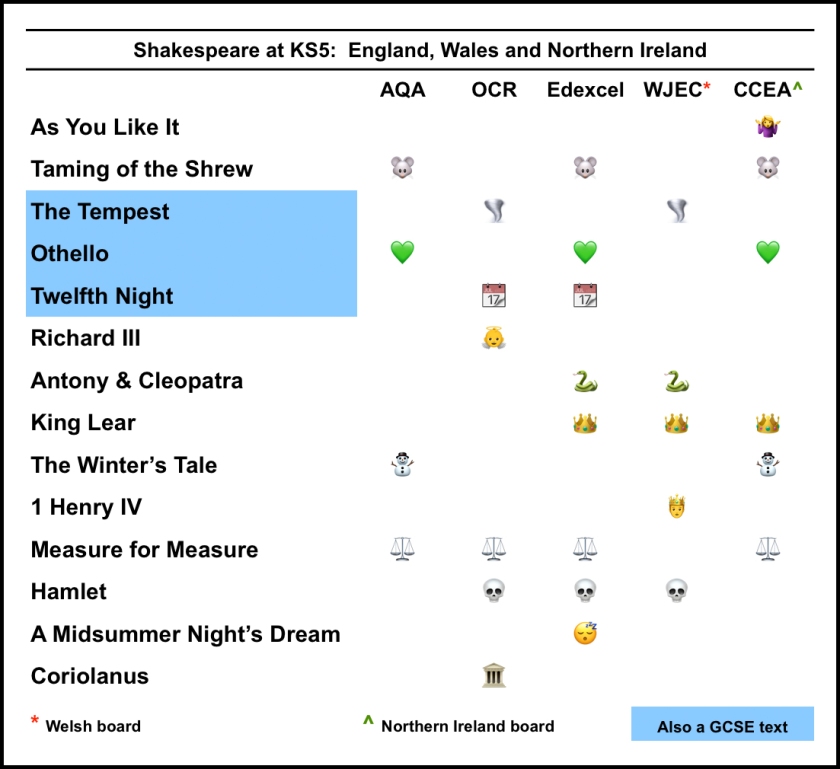

 Shakespeare is the only author that everyone over here has to study. Unless, it appears, you live in Scotland (and someone might be able to correct me on that if I have misread the SQA specification) …
 The Boar's Head, Eastcheap