I know you all, and will awhile uphold
The unyoked humour of your idleness:
Yet herein will I imitate the sun,
Who doth permit the base contagious clouds
To smother up his beauty from the world,
That, when he please again to be himself,
Being wanted, he may be more wonder’d at,
By breaking through the foul and ugly mists
Of vapours that did seem to strangle him. (PRINCE HAL: 1 Henry IV. I.ii)
I’d love to ascribe these lines to our leaders, but I reserve them for myself today …
WE CANNOT, MUST NOT, WIPE ART WITH ANTI-BACTERIAL WIPES BEFORE ALLOWING THE NEXT GENERATION TO HANDLE IT …
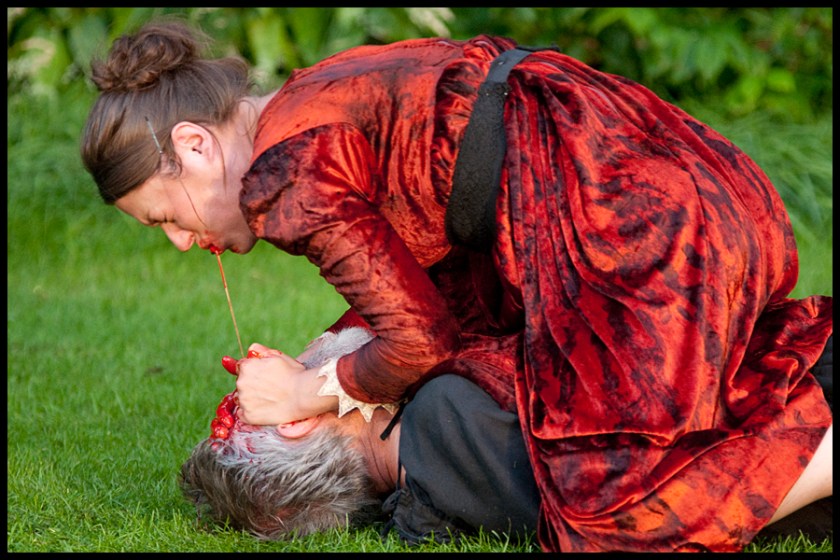
‘Out, vile jelly’: the blinding of Gloucester …
I took this picture – from King Lear – at the Cambridge Shakespeare Festival back in 2012. I often show it to pupils who try to tell me that Shakespeare is ‘boring‘. Or indeed I give them some of the plot details from Titus Andronicus that have caused such concern of late …
It’s taken me a little while to allow this one to sink in to the extent that it became a ‘crime’, but in the Dock, ladies and gentlemen of the Jury, I give you no less than the English Faculty of Cambridge University (or at least some members of that august institution) …
I entertain by picking brains Sell my soul, by dropping names (Elton John, 1974) Photo: Terry O’Neil
Richard III: Act I, Sc iii (Ponytail Shakespeare read-through)
Richard has been a part of my life, a surprisingly large part, for about six years or so. In fact, we might call him part of the ‘soundtrack of my life’, since I turned 40. So whilst I try and inevitably fail to do the play justice in these posts, one of the things that’s already settled is the Shakespeare’s Jukebox ‘Soundtrack Album’ that I publish at the end of my amble through the play. Some songs have been ringfenced, so that I don’t use them for any other play … this is one.
If there’s a decidedly ‘camp’ flavour to the jukebox, in fact to these posts (I mean: Mercury, Hasselhoff and now EJ?), it could be down to two factors:
I’m teaching Edward II, to two classes, at the moment (conspiracy theorists, and I like one as much as the next person, will note that these two plays were probably written within months of each other, if not simultaneously); and
this is a camp play. At some stage I might get stuck into the relationship between Richard and Buckingham (a personal theory that causes wide-eyed incredulity in my classes, more often than not)
I’ve often described it as a pantomime for grown-ups. Ironically, because a child’s pantomime is possibly the worst way I can think of spending an evening. Perhaps this takes on board the criticisms of those who favour other, more mature or ‘intellectual’ plays. Richard is gleefully childish and petulant, at least until he becomes king, and there are several times where I want to shout:
He’s behind you!
or similar, at members of the cast: Clarence, Hastings, the young Duke of York, the hapless Burghers of London, at the very least.
But … having ambled through the HVI plays for the first time this year, I have a completely different understanding of and respect for this play. The Bitch is back in Act I scene iii, and there can be only one Bitch (capitalisation intended), as we saw in The Hollow Crown …
Ponytail Shakespeare read-through – Richard III (Act I, scene i)
Larger than life. One of a kind. Brash on the outside, to mask an inner vulnerability. The ultimate showman, whose memory lives on long after his death. Freddie Mercury is all these things, too …
I’ve arrived at Richard III, the first play in my read-through that I know well, with a sense of awe, almost a fear of not doing him justice. Unusually, I’m as tentative as I might have been had I met him with a pathetic autograph book in my hand (or Mercury, whose death in 1991 touched me as few other celebrity deaths have: Prince and Sir Terry Pratchett are the only others that I register, emotionally). My relationship with Richard grows more obsessive and complex every time I teach him, and my recent book-buying seems unconciously centred round the historical Richard and the major players in his accession and downfall. I’ve also realised there is no way I can do this in the usual 1,000-ish-words-per-act format, so all I’m going to do is try to avoid 1,000 words-per-scene, if I can.
There’s a lot of unjustifiable hate out there for Titus Andronicus, I think.
Jonathan Bate introduces the play by saying that:
‘Even those who have approached Titus in a spirit of scholarly enquiry rather than critical judgement have been prejudiced by their distaste for the play […] nearly all scholars suppose that it is a very early work, a piece of crude and embarrassing juvenilia. I believe that every one of these arguments is wrong.
I’m with Prof. Bate. This was a rollercoaster ride. Although it does sketch issues we’ll see fleshed out in Lear and other ‘greats’, it’s a remarkable Revenge play, with a strong tragic journey and an utterly evil villain that surpasses any other I can readily think of. It also spoke strongly to me about public service, and the rewards thereof – especially for our armed forces.
So here’s my soundtrack album for the play. What’s missing?
Titus: Don’t push it … don’t push it or I’ll give you a war you won’t believe. Let it go.
Titus Andronicus, Act V
(subtitled, far too obviously for the UK football fans amongst us, ‘who ate all the pies?’)
I warned you! I WARNED YOU! Did I warn you?
Yes, I did. And so did Francis Bacon. And Jonathan Bate. And Fredson Bowers. We all said that revenge was likely to spiral out of control, because once you lose your faith in the law, and in divine justice too, all bets are off. And because every stroke in the ‘rally of revenge‘ is that much harder, has that much more spin on it than the last. Let’s mix our metaphors again: in this particular poker game, someone, eventually, is going to see your stake and raise you with everything they’ve got, not caring any more whether they win or lose. The chips, and what they represent, are suddenly and utterly unimportant …
BATE, Jonathan: ‘Introduction’, in Titus Andronicus (The Arden Shakespeare: London, 2003)
Some students see value in Literature as an end in itself. Others need a bit of persuading about why they have to study poetry, novels, and of course Shakespeare in particular (sigh).
‘What’s Shakespeare got to do with me? I want to be an air hostess!’
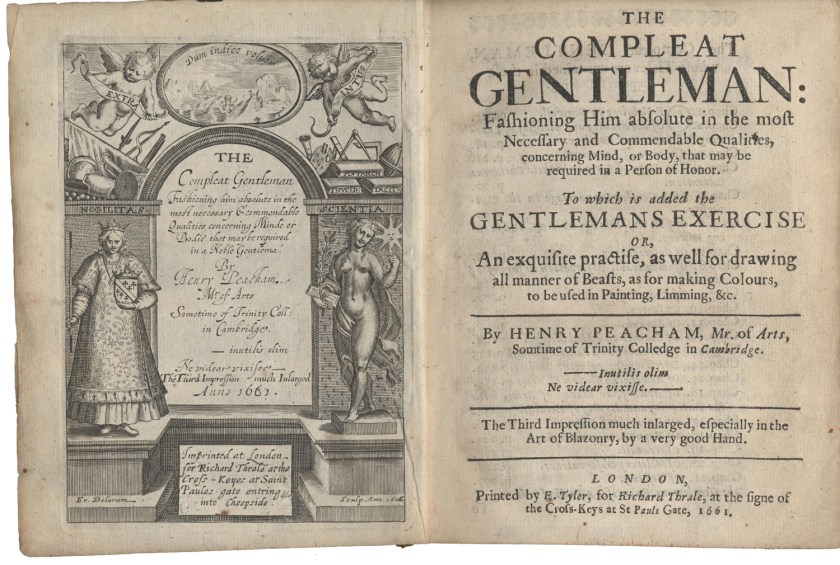
I was asked by a Year 9 pupil a few years ago. Henry Peacham, via Jonathan Bate, has an answer.
‘To sleep, perchance to dream – ay, there’s the rub’ (HAMLET: III.i.64)
Titus Andronicus: Act II
What tragedy would be complete without some element of the supernatural, as I have already intimated? This dreadful (in the sense of being full of dread, NOT poor quality) act begins with that classic Shakespearean trope, the bad night’s sleep:
‘I have been troubled in my sleep this night.’ (TITUS: II.i.9)
And Titus has every reason to be subconsciously troubled: although he begins the act quite enthusiastically:
‘The hunt is up’ (II.i.1)
He cannot imagine who the ‘dainty doe’ (DEMETRIUS: II.i. 26) might actually be ..
‘Good comedy is tragedy narrowly averted’ Jonathan Bate
The Two Gentlemen of Verona: Act V
Over the past year I’ve used the question ‘What’s in a name?’ more than once, dismissing labelling in its many forms, but this feels the best way of articulating my unease with The Two Gentlemen as I finish the play …
I’m a big fan of infographics, and these are great. Personally, I’d reverse the order, because who doesn’t enjoy a Shakespearean pie-chart (unless of course your name is Demetrius or Chiron)?
You know what an infograph (or infographic) is, right? It’s a chart or other visual depiction of information that is intended to be consumed and understood quickly. There are all kinds, from maps to timelines and more. Some of my favorites, of course, are Shakespeare infographs. Here are three of the many I’ve “clipped” and saved:
My friend (and occasional guest blogger here at The Bard and the Bible) Sue sent this one to me:
And this is one of many efforts to chart the various causes of death in Shakespeare’s plays:




 There’s a lot of unjustifiable hate out there for


 The Boar's Head, Eastcheap