Quote of the Week: 26 March 2018 (#34)

The long road to the civil war begins here …

BH Richard II 86536
Photo by me:  taken at the Cambridge Shakespeare Festival, 2014

This week’s quotation is from:  Charles R. Forker, ‘Introduction’, in William Shakespeare, Richard II (Arden Third Edition), (Thomson Learning:  London, 2002)

A recent Reddit thread discussed the extent to which the History plays critiqued the monarchy.  To be honest, I didn’t want to get involved, because it looked like a straight request for homework help, and yet, it was hard to resist such a fascinating subject …

Continue reading “Quote of the Week: 26 March 2018 (#34)”

Quote of the Week: 19 March 2018 (#33)

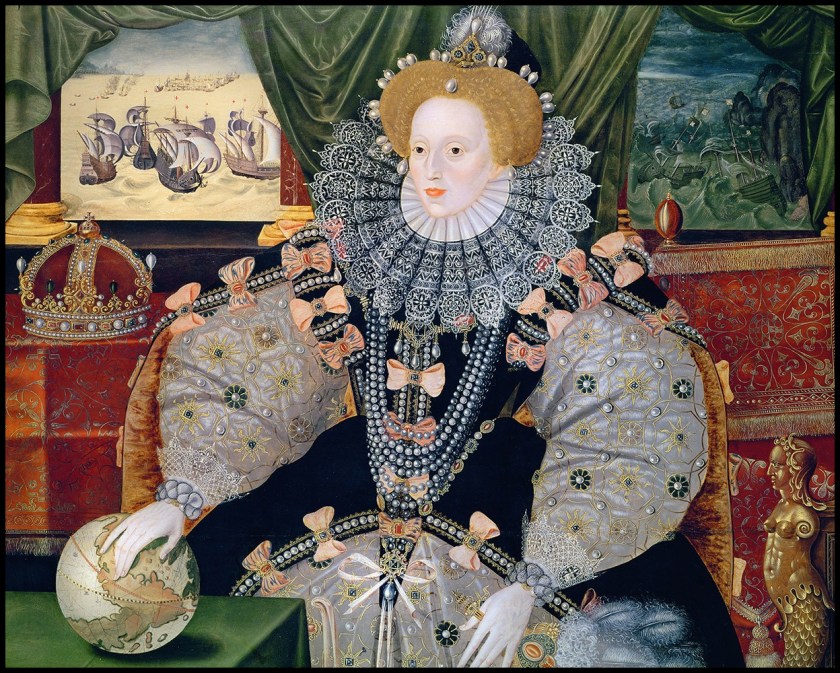
Sometimes we need to be reminded that our historical figures are human beings.

BH elizabeth armada portrait
‘The Armada Portrait’

This week’s quotation is taken from Garrett Mattingly, The Defeat of the Spanish Armada (ed. J.H. Elliott), (The Folio Society:  London, 2002)

– – –

This is just a humble tavern, and we’ve no real pretensions to royal patronage.  Prince Hal, of course is a regular, but he doesn’t behave very … ahem … regally, when he’s here, Lor’ bless and keep him.

But like every good English ale-house, we do have a portrait of Good Queen Bess behind the bar, and it’s this one.  This week, I’ve been thinking about Elizabeth I

Continue reading “Quote of the Week: 19 March 2018 (#33)”

Hapus Dydd Dewi Sant, look you!

Just how authentic are Shakespeare’s Welsh characters?

BH fluellen leek

‘if you can mock a leek, you can eat a leek’ [1]

Wales is my second home: my girlfriend is Welsh.  I lived there for a while, and visit frequently.  It’s a place I’ve come to know reasonably well, and to like very much.  One of the highlights of each year is watching the England vs Wales rugby union match – you simply haven’t tasted real passion and love of country until you’ve watched it on a big screen in a packed pub in North Wales (avoid wearing white, if you can).  They have a national anthem that genuinely moves me every time I hear it: inexplicably visceral and patriotic in a way that ‘God Save The Queen’ can never, ever be.  Take 90 seconds out of your life to watch this, below:

All this love doesn’t stop me from massively enjoying any opportunity to ‘mock the leek‘, but in an affectionate way …

Continue reading “Hapus Dydd Dewi Sant, look you!”

Quote of the Week: 26 February 2018 (#30)

Almost nothing seems to have changed in 400 years … as usual …

BH womans placesubtitled, ‘Food for powder

Matthew Beaumont:  Nightwalking: A Nocturnal History of London (London:  Verso Books, 2015)

My recent article on Gayle Rubin‘s important Feminist work, ‘The Traffic in Women’ touched upon what has been historically expected of women, especially working class ones.  Rubin takes a look at the Marxist position before developing it into a gender rather than class-specific argument:  the commodification of women in the marriage market.  It’s an excellent read.

And we see Rubin’s position everywhere in Shakespeare and the EMP, where women constantly struggle against the social imperative to marry a man who ticks boxes for their family / parents, love coming as an unexpected bonus.  Even comedies such as The Dream feature the tension between ‘kinship‘ and ‘companionate‘ marriages.

To say nothing of the pressures Elizabeth I was under, of course …

In my article, I dipped into Beaumont‘s book for a supporting quotation, but it’s been weighing on my mind.  I think it needs to be considered on its own merits.

Continue reading “Quote of the Week: 26 February 2018 (#30)”

Quote of the Week: 19 February 2018 (#29)

“Is black so base a hue?” Aaron, Titus Andronicus, Act IV scene ii …

BH devils-witches-dance
– back cover of Scott’s book –

AF Scott, Witch, Spirit, Devil, (White Lion Publishing:  London, 1974)

Whilst Black History Month isn’t celebrated in the UK until October, this is a bit of an international blog: about half of you are visitors from the US, and another quarter or so from elsewhere outside the UK – thank you, by the way!

So now, whilst I’m reading Scott’s book, feels like the time to look at this …

Continue reading “Quote of the Week: 19 February 2018 (#29)”

Cultural Capital 04: Gayle Rubin, ‘The Traffic In Women’

Who gives this woman away?

bh-woman-power

(For non-students, this is part of a series for my A Level students looking at important secondary texts which will assist their studies.)

Gayle Rubin, ‘The Traffic in Women:  Notes on the “Political Economy” of Sex’ (1975)

An [If] you be mine, I’ll give you to my friend;

And you be not, hang, beg, starve, die in the streets,

For, by my soul, I’ll ne’er acknowledge thee

(Lord Capulet, Romeo and Juliet, Act III, sc v)

and

I beg the ancient privilege of Athens,

As she is mine, I may dispose of her:

Which shall be either to this gentleman

Or to her death, according to our law.

(Egeus, A Midsummer Night’s Dream, Act I, sc I)

Not much fun, being a teenage girl in Shakespeare’s day, was it?  These intelligent, independent and emotional young women must often have felt like second-class citizens …

Continue reading “Cultural Capital 04: Gayle Rubin, ‘The Traffic In Women’”

PTS 10/059: I DO Believe in Fairies …

Puck and Ariel are first cousins – mischievous, not malicious …

BH cottingley fairies
Sir Arthur Conan Doyle was taken in by the Cottingley Fairies.  I might have been, too …

A Midsummer Night’s Dream, Act II

“You see, Wendy, when the first baby laughed for the first time, its laugh broke into a thousand pieces, and they all went skipping about, and that was the beginning of fairies.” […]

“And so,” he went on good-naturedly, “there ought to be one fairy for every boy and girl.”

“Ought to be? Isn’t there?”

“No. You see children know such a lot now, they soon don’t believe in fairies, and every time a child says, ‘I don’t believe in fairies,’ there is a fairy somewhere that falls down dead.”1

Discussing Act I, I alluded to the fact that my suspension of disbelief was more taxed by Helena‘s actions than by the whole idea of a fairy realm – how strange is that?

Continue reading “PTS 10/059: I DO Believe in Fairies …”

Quote of the Week: 12 February 2018 (#28)

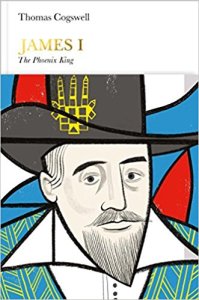
Should we pay more attention to James I before he became King of England?

BH cogwell james i

Thomas Cogswell, James 1:  The Phoenix King (Penguin Monarchs series), (Allen Lane:  London, 2017)

Studying or teaching Shakespeare’s plays, the figure of Elizabeth looms in the background, like the spectre at the feast.

We see it in the ever-present censorship, in the light of the Treasons Acts in 1571 and 1581, outlawing public discussion of the succession.  Or, more positively, in the ‘Gloriana’ cult that produced works like Spenser‘s The Faerie Queen, and flattering nods to Elizabeth wherever you look – like links between her and Theseus in A Midsummer Night’s Dream.  We see it in her discomfort with comparisons to Richard II, and the propagandic lionization of Henry VII.

Reading Cogswell‘s short, sympathetic biography has made me reassess the extent to which we / I ignore James until the succession question becomes absolutely critical.

Continue reading “Quote of the Week: 12 February 2018 (#28)”

PTS 09/056: These Words Are Not Mine …

How could I dislike this so much? Was it the play, or actually me?

BH claudius hamlet

CLAUDIUS:   How fares our cousin Hamlet?

HAMLET:   Excellent, i’ faith; of the chameleon’s dish, I eat the air, promise-cramm’d. You cannot feed capons so.

CLAUDIUS:  I have nothing with this answer, Hamlet. These words are not
mine.

HAMLET:  No, nor mine now.  (Act III, scene ii)

Love’s Labour’s Lost:  Act V

ME:  Thank God for that!

HER:  You’ve finished?

ME:  Yup!

HER:  Great, so now you never have to read it again.

(pause)

Continue reading “PTS 09/056: These Words Are Not Mine …”

PTS 09/055: The Rough Wooing of the Monstrous Regiment

Where is the ‘son-in-law’ material in LLL?


BH NIgel
Dad, this is Nigel … we’re in love!

Love’s Labour’s Lost:  Act IV

My life has been filled with obsessions, and for reasons too complex to go into here, about twenty-five years ago, one of them was Scottish history.  With no knowledge ever completely wasted, it’s contributed to where and who I am today, struggling with this play, and especially to find any kind of empathy with its male characters.

Put simply, if I had a daughter, none of these men would be son-in-law material …

Continue reading “PTS 09/055: The Rough Wooing of the Monstrous Regiment”