PTS 10/063: A Midsummer Night’s Dream Soundtrack

The Dream seemed an easy hit for songs from several genres and decades …

bh-wurlitzer

As ever, Shakespeare’s Jukebox provides a quick chance to cut loose and be a little mischievous between read-through plays.

Also, to embarrass myself, not least with my dodgy 80s credentials …

Finally to ask the time-honoured question:

What’s missing?

Let me know below!

Continue reading “PTS 10/063: A Midsummer Night’s Dream Soundtrack”

Quote of the Week: 05 March 2018 (#31)

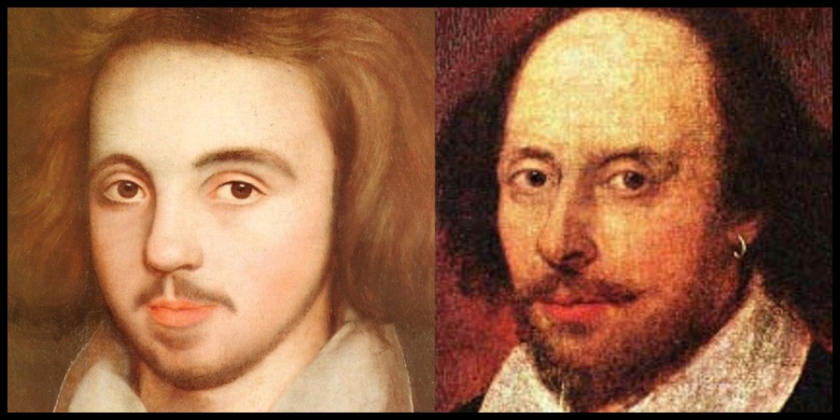
They could be twins … NOT the authors!

BH marlowe shakespeareJohn Gielgud, ‘Richard II’ in Charles Ede (ed.), Introductions to Shakespeare, (London:  Folio Society, 1977) p.59

[and a small celebration of this as my 201st post]

The Wheel of Fortune moves inexorably away from Edward II at school (which students will have to compare to Tennyson‘s Maud in their exam – easy peasy, whatever they may think, if they work hard and LISTEN between now and then), and in terms of the Ponytail Shakespeare read-through, to Richard II.

I can’t be the only one to reflect that the two plays are remarkably similar.  Indeed, I’ve chosen this week’s quotation as an intrigiung bridge between them.

Continue reading “Quote of the Week: 05 March 2018 (#31)”

PTS 10/062: Wakey, Wakey …

I took you for granted for so long: I’m sorry …


BH MND11 76090
image:  Abel Guerrero

Being a Production Photographer has its moments – this is my favourite image from The Dream in Cambridge, 2012.

Ponytail Shakespeare read-through:  A Midsummer Night’s Dream, Act V.

One of the things about a project like this read-through it that it gives you a certain discipline.  In this case, although my timetable may be only notionally followed, it has forced me to read or re-read plays that I might not have, otherwise.  Occasionally (Love’s Labour’s Lost, I’m looking at YOU), my reservations have been fully justified. On other occasions, this new-found steel in my soul has been intensely rewarding.  I might not otherwise have read the Henry VI plays, for example.  Or, indeed, re-read The Dream in any hurry (believing I knew it ‘well enough’), and that would have been a shame …

Continue reading “PTS 10/062: Wakey, Wakey …”

Hapus Dydd Dewi Sant, look you!

Just how authentic are Shakespeare’s Welsh characters?

BH fluellen leek

‘if you can mock a leek, you can eat a leek’ [1]

Wales is my second home: my girlfriend is Welsh.  I lived there for a while, and visit frequently.  It’s a place I’ve come to know reasonably well, and to like very much.  One of the highlights of each year is watching the England vs Wales rugby union match – you simply haven’t tasted real passion and love of country until you’ve watched it on a big screen in a packed pub in North Wales (avoid wearing white, if you can).  They have a national anthem that genuinely moves me every time I hear it: inexplicably visceral and patriotic in a way that ‘God Save The Queen’ can never, ever be.  Take 90 seconds out of your life to watch this, below:

All this love doesn’t stop me from massively enjoying any opportunity to ‘mock the leek‘, but in an affectionate way …

Continue reading “Hapus Dydd Dewi Sant, look you!”

Quote of the Week: 26 February 2018 (#30)

Almost nothing seems to have changed in 400 years … as usual …

BH womans placesubtitled, ‘Food for powder

Matthew Beaumont:  Nightwalking: A Nocturnal History of London (London:  Verso Books, 2015)

My recent article on Gayle Rubin‘s important Feminist work, ‘The Traffic in Women’ touched upon what has been historically expected of women, especially working class ones.  Rubin takes a look at the Marxist position before developing it into a gender rather than class-specific argument:  the commodification of women in the marriage market.  It’s an excellent read.

And we see Rubin’s position everywhere in Shakespeare and the EMP, where women constantly struggle against the social imperative to marry a man who ticks boxes for their family / parents, love coming as an unexpected bonus.  Even comedies such as The Dream feature the tension between ‘kinship‘ and ‘companionate‘ marriages.

To say nothing of the pressures Elizabeth I was under, of course …

In my article, I dipped into Beaumont‘s book for a supporting quotation, but it’s been weighing on my mind.  I think it needs to be considered on its own merits.

Continue reading “Quote of the Week: 26 February 2018 (#30)”

Cultural Capital 03: Marx and Engels: The Communist Manifesto

Prepare yourself for a glorious improvement in your AO5 skills, comrades!

(For non-students, this is part of a series for my A Level students looking at important secondary texts which will assist their studies.)

BH Marx 1


‘I am not a Marxist’ – Karl Marx

‘Reading The Communist Manifesto does not make you a Communist, any more than reading the Bible makes you a Christian’

says Nigel Cawthorne in the introduction to my copy.  This reassuring sentiment is only slightly undermined by his point that:

‘While reading The Communist Manifesto, it is as well to remember that millions of people have shed blood over this document.’ As they have, to be fair, with last month’s text …

THIS is the power of ideas and words, people. Continue reading “Cultural Capital 03: Marx and Engels: The Communist Manifesto”

A Bookshelf Update … and a question or two

Being overwhelmed with books is a problem I’ve had to get used to …

BH books bedroom
NOT quite my situation, yet … image: curatormagazine.com

Today, I looked EVERYWHERE for a book that I wanted to quote from and couldn’t find it …

I know you’re in here, somewhere.  You were a Christmas present; when I got back from my second home in Wales I put you down when I unpacked. You’ve not left the flat.  The only place I didn’t check was the kitchen: it’s got no windows and I don’t go in there if I can help it.

Where are you hiding? *

Continue reading “A Bookshelf Update … and a question or two”

PTS 10/060: The Gods DO play dice …

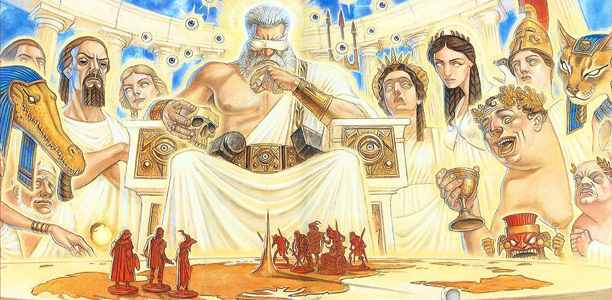
Act III places us at the game table, jostling Shakespeare for a view of the goings-on in that VERY busy wood …

BH Discworld Gods
‘No smiting.  Not up here.  It is the rules.  You want fight, you get your humans fight his humans. [1]
A Midsummer Night’s Dream, Act III: with apologies to Albert Einstein [2]

On reflection, it seems odd that as a child experiencing / undergoing / suffering a Catholic education, once a year, on our ‘Saint’s Day’ –  St Martin de Porres: 03 November – we were treated to a film in the school hall which was invariably a Ray Harryhausen epic.

Not that I want to complain.  I loved them, and still do.

They fostered an appetite for the ancient world – for Perseus, Theseus, Hercules, Jason … any number of  heroes and their associated monsters.  And, like the Book of Genesis, they’ve proved to be invaluable in teaching Literature.

Continue reading “PTS 10/060: The Gods DO play dice …”

Quote of the Week: 19 February 2018 (#29)

“Is black so base a hue?” Aaron, Titus Andronicus, Act IV scene ii …

BH devils-witches-dance
– back cover of Scott’s book –

AF Scott, Witch, Spirit, Devil, (White Lion Publishing:  London, 1974)

Whilst Black History Month isn’t celebrated in the UK until October, this is a bit of an international blog: about half of you are visitors from the US, and another quarter or so from elsewhere outside the UK – thank you, by the way!

So now, whilst I’m reading Scott’s book, feels like the time to look at this …

Continue reading “Quote of the Week: 19 February 2018 (#29)”

Cultural Capital 04: Gayle Rubin, ‘The Traffic In Women’

Who gives this woman away?

bh-woman-power

(For non-students, this is part of a series for my A Level students looking at important secondary texts which will assist their studies.)

Gayle Rubin, ‘The Traffic in Women:  Notes on the “Political Economy” of Sex’ (1975)

An [If] you be mine, I’ll give you to my friend;

And you be not, hang, beg, starve, die in the streets,

For, by my soul, I’ll ne’er acknowledge thee

(Lord Capulet, Romeo and Juliet, Act III, sc v)

and

I beg the ancient privilege of Athens,

As she is mine, I may dispose of her:

Which shall be either to this gentleman

Or to her death, according to our law.

(Egeus, A Midsummer Night’s Dream, Act I, sc I)

Not much fun, being a teenage girl in Shakespeare’s day, was it?  These intelligent, independent and emotional young women must often have felt like second-class citizens …

Continue reading “Cultural Capital 04: Gayle Rubin, ‘The Traffic In Women’”